
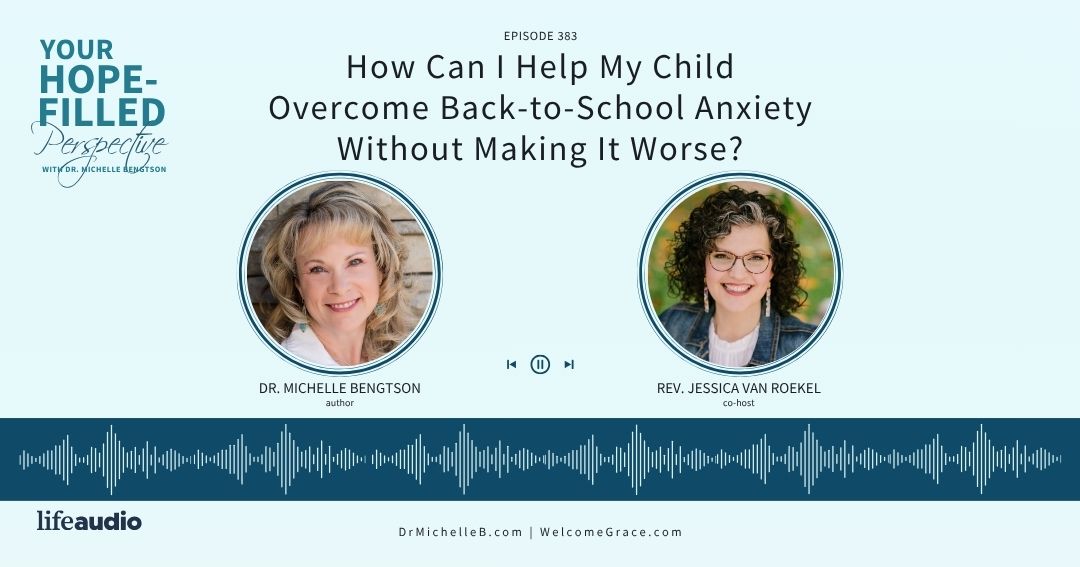
Listen to the podcast below and on your favorite platform or Watch on YouTube:




Episode Summary:
What if the tears, stomachaches, or sudden mood swings your child is experiencing right now aren’t just “back-to-school nerves”…but signs of anxiety their brain doesn’t yet know how to process?
As backpacks are packed and school doors reopen, many families are quietly navigating a surge of stress, fear, and emotional overwhelm. Your child may not have the words to explain what they’re feeling—but their behavior is speaking loudly. And if you’ve ever felt unsure how to respond…wondered whether to push them forward or pull them close…or questioned if you’re helping or accidentally making it worse—you are not alone. In today’s episode, we’re uncovering what’s really happening beneath the surface of back-to-school anxiety and equipping you with both the neuroscience and the Scripture-based truth you need to help your child move from fear to peace—and from overwhelm to confidence.
Quotables from the episode:
- If you’ve been asking yourself, “Why is my child so anxious about going back to school?” or “How can I help my child manage school anxiety without making it worse?”—you’re not alone. Back-to-school anxiety in kids is more common than many parents realize, showing up as tears, resistance, physical complaints, or even sudden behavioral changes. But what if those reactions aren’t defiance…what if they’re signals from a child’s brain overwhelmed by stress and uncertainty? In today’s episode, we’re diving into the real causes of school anxiety, what’s happening in your child’s brain, and practical, faith-based strategies you can use to help your child feel calm, confident, and secure as they head into a new school year. For today’s conversation, we’re discussing some of your pressing questions as well as some of those topics I wish I could’ve asked when my children were school-aged.
- Families everywhere are gearing up for a new school year, and while it can be exciting, it can also bring a lot of stress and anxiety—for both kids and parents.
- Back-to-school season often stirs up a mix of emotions—anticipation, excitement, but also fear, uncertainty, and overwhelm. And what many parents don’t realize is that these emotional responses have both spiritual and neurological components.
- That’s why I’m so glad we’re talking about this today. Because parents aren’t just looking for behavior tips—they want to understand what’s really going on inside their child and how to respond in a way that brings peace instead of more pressure.
- And the good news is, God has equipped us with both truth and tools. When we understand how the brain works and align that with Scripture, we can help our children—and ourselves—move from anxiety to peace and confidence.
- Let’s start with the big question: Why does back-to-school season trigger so much anxiety in kids?
- That’s such an important question. At its core, anxiety is the brain’s response to perceived threat or uncertainty. Back-to-school introduces a lot of “unknowns”—new teachers, new routines, social dynamics, academic expectations.
- When the brain perceives uncertainty, it activates the stress response system—specifically the amygdala—which essentially asks, “Am I safe?” If the brain isn’t sure, it defaults to caution, and that’s when anxiety shows up.
- So even if there’s no real danger, the brain can still respond as if there is?
- Exactly. The brain is wired for protection, not perfection. It would rather overreact than miss a potential threat. For children especially—whose brains are still developing—this response can feel overwhelming.
- That makes so much sense. I think sometimes parents assume their child is just being dramatic or resistant.
- Yes, and that’s where we need a mindset shift. What looks like defiance or avoidance is often distress.
- Instead of asking, “What’s wrong with my child?” we should ask, “What is my child’s brain trying to process or protect against?”
- That’s such a compassionate reframe.
- And it aligns with Scripture. Psalm 56:3 says, “When I am afraid, I put my trust in You.” Notice it doesn’t say if—it says when. Fear is a normal human experience. The key is what we do with it. A common response to worry, fear, and anxiety is to try to avoid the thing that makes us anxious. It works in the short-term, but in the long-term what it does is reinforces the stimulus that makes us anxious so we become more and more anxious. For example, I’ve had patients who were afraid of driving on the freeway, so they avoided it. That avoidance temporarily decreased their anxiety, but it ended up reinforcing their fear and it became more crippling in their life, so they then became more afraid of driving on busy roads, then more afraid of even driving on less busy roads, then became afraid of leaving their home. The key is that we need to learn how to better respond to anxiety, NOT try to avoid it.
- What are some ways anxiety shows up in children that parents might not immediately recognize?
- Great question, because anxiety doesn’t always look like worry. In children, it often shows up as:
- Irritability or emotional outbursts
- Physical complaints like stomachaches or headaches
- Avoidance—refusing to go to school or participate
- Trouble sleeping
- Difficulty concentrating
- Sometimes anxiety even looks like perfectionism or overachievement.
- That’s interesting—so even a child who seems like they’re doing everything “right” could actually be anxious?
- Absolutely. That child might be driven by a fear of failure or rejection or even abandonment.
- I think that’s important for parents to hear, because we often celebrate the outward behavior without understanding the internal struggle.
- Yes, and when anxiety goes unrecognized, it can intensify. That’s why awareness is the first step toward helping our children.
- Michelle, I think one of the biggest questions parents are asking right now is this: “Is this normal back-to-school stress, or is it actually anxiety?” So, how can parents tell the difference between normal nerves and something that needs more attention?
- That’s such an important place to start. Some level of nervousness is completely normal—our brains are wired to respond to new or uncertain situations. But anxiety goes beyond that.
- From a neuroscience perspective, anxiety is when the brain’s alarm system—the amygdala—is activated more frequently or intensely, even when there’s no true danger.
- As a parent, I encourage you to look at three things: intensity, duration, and impact. If your child’s distress is ongoing, escalating, or interfering with daily life—like sleep, appetite, or school attendance—it’s likely more than typical stress.
- Is there a change in behavior, mood, or attitude from the middle of summer to now?
- Is the anxiety persistent?
- Is it escalating?
- Is it interfering with daily functioning?
- If the answer is yes, it’s time to step in more intentionally.
- And from a faith perspective, I love how Scripture normalizes fear but redirects it. Psalm 34:4 says, “I sought the Lord, and He answered me; He delivered me from all my fears.” Fear may come—but it doesn’t have to lead.
- That leads into another question I hear a lot: “Why is my child suddenly anxious about school when they were fine before?”
- Yes, and that can feel confusing for parents. But children’s brains are constantly developing, and their capacity to think, imagine, and anticipate is growing.
- So a child who was fine last year may now be more aware of social pressures, academic expectations, or even “what if” scenarios.
- Neurologically, their brain is better at predicting outcomes—but not always accurate ones. So they can imagine worst-case scenarios and respond as if those are real threats.
- Spiritually, this is where we help them take those “what if” thoughts captive. 2 Corinthians 10:5 reminds us to “take every thought captive and make it obedient to Christ.” We can gently teach our children to question fearful thoughts and replace them with truth.
- What are some signs of anxiety in children that parents might miss?
- Anxiety in children is often expressed through the body or behavior rather than words. You might see stomachaches, headaches, irritability, tears, avoidance, or even perfectionism.
- What’s happening in the brain is that stress hormones are being released, and the body is preparing for danger—even if the “danger” is just walking into a classroom.
- So instead of assuming misbehavior, we ask, “Is this distress?”
- And this is where compassion matters deeply. Colossians 3:12 encourages us to “clothe yourselves with compassion, kindness, humility, gentleness and patience.” That’s exactly what our anxious children need from us.
- Let’s get really practical. What are some common mistakes parents make when trying to help an anxious child? Maybe things they might be doing that they don’t realize could actually be making the situation worse?
- One of the most common mistakes is trying to eliminate the anxiety altogether. It’s easy to think that this is helpful, but ultimately, it will create a fearful, avoidant child lacking in good coping skills.
- Parents might also try reassuring excessively or removing every stressor, thinking that is helping their child. While that comes from a place of love, it actually teaches the brain that the situation is dangerous and needs to be avoided.
- The goal isn’t to remove anxiety—it’s to teach children how to move through it with confidence.
- Another mistake is dismissing or minimizing their feelings—saying things like, “You’re fine,” or “There’s nothing to worry about.”
- I think many parents say that because they want to comfort their child.
- Of course. Comforting is good, but what children need first is validation, not correction. Our feelings are powerful, and making comments like “You’re fine,” teaches children that there is something wrong with them, and that they can’t trust their parent to be a safe place to share their feelings.
- When we say, “I see that you’re nervous, and that makes sense,” we calm the brain’s alarm system. It opens the door for further conversation, and instills trust between child and parent.
- So validation actually helps regulate the brain?
- Yes, it does. It engages the prefrontal cortex—the part of the brain responsible for reasoning and emotional regulation.
- Okay, so if those are the “don’ts,” what are the “do’s”?
- Here are a few key strategies:
-
- Validate their feelings
- Name the anxiety—help them put words to it
- Teach coping skills like deep breathing or grounding
- Encourage gradual exposure to what they fear
- Model calm and confidence
- That last one feels big—modeling calm.
- It is. Children borrow our nervous system. If we are anxious, they will feel it. But when we are calm, we communicate safety.
- That’s both encouraging and convicting. And it brings us to Scripture again. 2 Timothy 1:7 reminds us, “For God has not given us a spirit of fear, but of power and of love and of a sound mind.” We can model that sound mind for our children.
- Okay, this is a tough one—and I think every parent has wondered this: “Should I make my child go to school if they’re anxious?”
- This is such a tender balance. Avoidance actually strengthens anxiety over time because the brain learns, “If I escape, I’m safe.” But gentle, supported exposure helps retrain the brain to recognize, “I can do this, and I’ll be okay.”
- So yes, in most cases, we do want to help our child go to school—but with support, preparation, and encouragement. We don’t push harshly, and we don’t rescue completely—we walk alongside.
- And I often remind parents of Joshua 1:9: “Be strong and courageous…for the Lord your God will be with you wherever you go.” We’re not sending our children into school alone—we’re sending them with God’s presence.
- What about for kids who are especially anxious?
- I recommend creating a “preview” experience:
- Visit the school
- Meet the teacher if possible
- Walk through the schedule
- The more familiar something feels, the less threatening it becomes to the brain.
- Another tool is teaching children simple calming techniques. For example:
- Deep breathing: inhale for 4, exhale for 6
- Grounding: naming 5 things they see, 4 things they feel, 3 things they hear, 2 things they smell, 1 thing they taste.
- These help regulate the nervous system in real time.
- I love that those are simple enough for kids to remember. And parents can practice these with their children, which reinforces connection.
- What about the spiritual side? I know you emphasize incorporating biblical truths with science-backed tools. How can parents incorporate faith into this?
- This is where we have such a beautiful advantage as believers. We can teach our children to bring their fears to God. Philippians 4:6–7 says, “Do not be anxious about anything, but in everything, by prayer and petition, with thanksgiving, present your requests to God…”
- We can help our children turn anxious thoughts into prayers. That’s such a powerful habit to build early. And pairing prayer with truth—like memorizing Scripture—helps rewire thought patterns over time.
- I can almost hear some parents asking, “What if I’m making my child’s anxiety worse without realizing it?”
- That’s such an honest and humble question. And the truth is—sometimes, unintentionally, we can reinforce anxiety. For example, over-reassuring or removing every stressor can teach the brain that the situation is dangerous.
- But it’s key for parents to monitor their own emotions. Our kids pay attention not only to what we say but how we act. If we are anxious, they will pick up on that, and it will communicate to them that they have a reason to be anxious.
- But here’s the good news: you don’t have to be perfect to be effective.
- The key is to validate your child’s feelings while still encouraging growth.
- You might say, “I see that this feels scary, and I believe you can handle it.”
- That balance engages both emotional safety and cognitive strength.
- And Philippians 4:6–7 reminds us that when we bring our anxieties to God, His peace guards our hearts and minds. That’s true for parents, too.
- Let’s get really practical. How can I calm my child down in the moment—like during those stressful school mornings?
- In those moments, we want to focus on calming the body first, because a dysregulated brain can’t process logic.
- Simple tools like deep breathing—inhale for four, exhale for six—can help reset the nervous system.
- Grounding exercises, like naming what they can see, hear, and feel, bring the brain out of panic mode.
- And your presence matters more than your words. A calm tone, steady posture, even a gentle touch communicates safety.
- Psalm 46:10 says, “Be still, and know that I am God.” Sometimes we help our children access that stillness physically before they can access it spiritually.
- That’s so helpful. But parents also wonder, “What do I actually say to my child when they’re anxious?”
- Words matter. We want to avoid dismissing (“You’re fine”) or amplifying fear (“This is really hard”). Instead, we aim for truth and reassurance.
- Try phrases like:
- “I can see this feels scary.”
- “You’re not alone—I’m with you.”
- “You’ve done hard things before.”
- “We can trust God with this together.”
- What we’re doing is helping reframe their thoughts while keeping connection.
- And Isaiah 41:10 is a beautiful truth to speak over them: “Do not fear, for I am with you… I will strengthen you and help you.”
- How do we help our kids not just survive school—but actually build confidence?
- Confidence comes from experience—not avoidance. Each time a child faces something hard and gets through it, the brain rewires to say, “I can handle this.” So, we celebrate effort, not just outcomes. We remind them of past successes. And we gradually increase challenges.
- Spiritually, we anchor their identity not in performance, but in who God says they are. When a child knows they are loved, chosen, and never alone, that becomes the foundation for real confidence.
- Let’s talk about a harder situation: What if my child refuses to go to school altogether?
- That’s incredibly stressful for parents, and it often signals more significant anxiety. In those cases, we want to respond with both compassion and structure. We validate the fear, but we don’t allow avoidance to become the long-term solution. And we may need to involve teachers, counselors, or professionals to create a support plan. This isn’t a failure—it’s an opportunity for support.
- Galatians 6:2 reminds us to “carry each other’s burdens.” Sometimes that means inviting others into the process.
- And finally, when should a parent seek professional help?
- If anxiety is persistent, worsening, or interfering with daily functioning—like school attendance, relationships, or physical health—it’s time to seek support. Early intervention can make a tremendous difference. And I always remind parents—seeking help is not a sign of weakness; it’s a step of wisdom and love.
- Proverbs 11:14 says, “In the multitude of counselors there is safety.” God often provides help through others.
- Before we wrap up, I want to talk directly to the parents listening. Because let’s be honest—this season can be stressful for them too.
- Absolutely. Parents often carry their own anxieties—about their child’s success, safety, social experiences.
- What would you say to the parent who feels overwhelmed?
- First, you’re not alone. And second, your presence matters more than your perfection. Your child doesn’t need a flawless parent—they need a connected one.
- And remember, your peace sets the tone for your home. Isaiah 26:3 says, “You will keep in perfect peace those whose minds are steadfast, because they trust in You.”
- When we anchor ourselves in God’s truth, we create an environment of peace for our children. Also, don’t hesitate to seek help if needed. There’s no shame in reaching out to a counselor or specialist. Early support can make a significant difference.
- As you head into this new school season, may you and your children walk in peace, confidence, and the assurance that God is with you every step of the way.
Scripture References:
- Psalm 56:3 says, “When I am afraid, I put my trust in You.”
- Colossians 3:12 encourages us to “clothe yourselves with compassion, kindness, humility, gentleness and patience.”
- 2 Timothy 1:7 reminds us, “For God has not given us a spirit of fear, but of power and of love and of a sound mind.”
- Joshua 1:9 “Be strong and courageous…for the Lord your God will be with you wherever you go.”
- Psalm 46:10 says, “Be still, and know that I am God.”
- Isaiah 41:10 “Do not fear, for I am with you… I will strengthen you and help you.”
- Galatians 6:2 reminds us to “carry each other’s burdens.”
- Proverbs 11:14 says, “In the multitude of counselors there is safety.”
- Philippians 4:6–7 says, “Do not be anxious about anything, but in everything, by prayer and petition, with thanksgiving, present your requests to God…”
- Isaiah 26:3 says, “You will keep in perfect peace those whose minds are steadfast, because they trust in You.”
Recommended Resources: (If there are affiliate links in this post, meaning, if you click through and make a purchase, I may receive a commission (at no extra cost to you)).
- Reframing Rejection: How Looking Through a Different Lens Changes Everything By Jessica Van Roekel
- Sacred Scars: Resting in God’s Promise That Your Past Is Not Wasted by Dr. Michelle Bengtson
- The Hem of His Garment: Reaching Out To God When Pain Overwhelms by Dr. Michelle Bengtson, winner AWSA 2024 Golden Scroll Christian Living Book of the Year and the 2024 Christian Literary Awards Reader’s Choice Award in the Christian Living and Non-Fiction categories
- YouVersion 5-Day Devotional Reaching Out To God When Pain Overwhelms
- Today is Going to be a Good Day: 90 Promises from God to Start Your Day Off Right by Dr. Michelle Bengtson, AWSA Member of the Year, winner of the AWSA 2023 Inspirational Gift Book of the Year Award, the 2024 Christian Literary Awards Reader’s Choice Award in the Devotional category, the 2023 Christian Literary Awards Reader’s Choice Award in four categories, and the Christian Literary Awards Henri Award for Devotionals
- YouVersion Devotional, Today is Going to be a Good Day version 1
- YouVersion Devotional, Today is Going to be a Good Day version 2
- Revive & Thrive Women’s Online Conference
- Revive & Thrive Summit 2
- Breaking Anxiety’s Grip: How to Reclaim the Peace God Promises by Dr. Michelle Bengtson, winner of the AWSA 2020 Best Christian Living Book First Place, the first place winner for the Best Christian Living Book, the 2020 Carolina Christian Writer’s Conference Contest winner for nonfiction, and winner of the 2021 Christian Literary Award’s Reader’s Choice Award in all four categories for which it was nominated (Non-Fiction Victorious Living, Christian Living Day By Day, Inspirational Breaking Free and Testimonial Justified by Grace categories.)
- YouVersion Bible Reading Plan for Breaking Anxiety’s Grip
- Breaking Anxiety’s Grip Free Study Guide
- Free PDF Resource: How to Fight Fearful/Anxious Thoughts and Win
- Hope Prevails: Insights from a Doctor’s Personal Journey Through Depression by Dr. Michelle Bengtson, winner of the Christian Literary Award Henri and Reader’s Choice Award
- Hope Prevails Bible Study by Dr. Michelle Bengtson, winner of the Christian Literary Award Reader’s Choice Award
What looks like defiance may actually be anxiety. When we understand what’s happening in a child’s brain, we can respond to the need beneath the behavior instead of reacting to the behavior itself. Share on X Back-to-school anxiety isn’t always obvious. A child’s sudden mood changes, physical complaints, or resistance may be their brain’s way of signaling that something feels unsafe or uncertain. Share on X
Social Media Links for Host and Co-Host:
For more hope, stay connected with Dr. Bengtson at:
Order Book Sacred Scars / Order book The Hem of His Garment / Order book Today is Going to be a Good Day / Order Book Breaking Anxiety’s Grip / Order Book Hope Prevails / Order Book Hope Prevails Bible Study / Website / Blog / Facebook / Twitter (@DrMBengtson) / LinkedIn / Instagram / Pinterest / YouTube / Podcast on Apple
About Co-Host Rev. Jessica Van Roekel:
 Jessica Van Roekel is a worship leader, speaker, and writer who believes that through Jesus, personal histories don’t need to define the present or determine the future. She inspires, encourages, and equips others to look at life through the lenses of hope, trust, and God’s transforming grace. Jessica lives in rural Iowa surrounded by wide open spaces which remind her of God’s expansive love. She loves fun earrings, good coffee, and connecting with others.
Hosted By: Dr. Michelle Bengtson
Audio Technical Support: Ashton Bengtson


