

A family’s mental health is shaped by more than whether anyone in the family has been diagnosed with a mental health condition. It is also shaped by the emotional climate of the home, the way family members communicate, how stress is handled, whether people feel safe enough to be honest, and whether connection remains possible when life gets difficult.
That matters because every family experiences stress.
The beginning of a school year can bring changing schedules, increased responsibilities, academic pressure, extracurricular commitments, and transitions. But family stress doesn’t disappear when the school calendar does. Maybe your family is navigating young children, teenagers, college students, adult children, marriage challenges, aging parents, health concerns, demanding careers, or simply the cumulative weight of too many responsibilities.
A mentally healthy family isn’t a family without conflict, disappointment, anxiety, or difficult seasons. A mentally healthy family is one that develops ways to recognize stress, communicate honestly, repair relationships, stay connected, and seek help when circumstances become more than the family can manage alone.
7 Practices that Help Families Thrive Under Stress
Building a mentally healthy family doesn’t require getting everything right. These seven practices can help create a healthier foundation:
1. Make emotional honesty safer than emotional avoidance
One of the most important things families can cultivate is an environment where people can tell the truth about how they are doing.
That doesn’t mean every family member needs to share every thought or feeling at every moment. Healthy emotional communication includes appropriate boundaries. But when family members learn that sadness, frustration, fear, disappointment, or uncertainty will automatically be dismissed, criticized, or met with an attempt to fix the problem, they may eventually stop talking.
Emotional avoidance can create distance even when everyone is living under the same roof.
Instead, practice curiosity before correction. A simple response such as, “That sounds really difficult. Tell me more,” can communicate that another person’s emotional experience is welcome and considered important.
This is especially important as children mature into teenagers and adults. A relationship that once depended on a parent providing answers gradually needs to become one where both people can bring honesty, respect, and curiosity to the conversation.
2. Learn to recognize stress before it becomes a family crisis
Families often notice stress only after it has already affected everyone’s behavior.
Someone becomes unusually irritable. Another person withdraws. Sleep deteriorates. Patience disappears. Small inconveniences suddenly produce disproportionately large reactions. Communication becomes shorter and more defensive.
Stress affects attention, emotional regulation, decision-making, and our capacity to respond thoughtfully. When cognitive and emotional resources are already stretched, even ordinary family demands can feel overwhelming.
Learning to recognize those early warning signs gives a family an opportunity to respond before stress becomes conflict.
That might sound like, “We’ve all been running hard lately. What do we need to change?” rather than waiting until someone explodes.
For parents, the way we respond to stress can also influence how our children learn to respond to stress.
Family mental health improves when stress becomes something the family can name rather than something everyone silently absorbs.
3. Protect connection when life gets busy
Connection is not simply spending time in the same physical space. A family can eat dinner together while everyone is looking at a screen, or live in the same house while feeling emotionally disconnected.
Building a mentally healthy family requires protecting moments of genuine attention and connection.
For some families, that may be a shared meal. For others, it may be a weekly walk, a Saturday morning coffee, a phone call with an adult child, a date night, or simply sitting together without everyone rushing toward the next obligation.
This matters because human beings are wired for connection. Meaningful relationships provide belonging, perspective, encouragement, and support during stressful seasons.
But connection doesn’t have to be elaborate. Often, consistency matters more than complexity.
If you’re interested in the broader relationship between connection and mental health, I’ve written about the importance of healthy relationships as part of mental well-being before.
4. Practice repair instead of expecting perfection
Every family has conflict. The goal isn’t to eliminate it.
What matters is what happens afterward.
Healthy families learn to repair.
Repair might mean apologizing without adding a justification. It might mean acknowledging that your tone was hurtful. It might mean returning to a conversation after everyone has had time to calm down.
Sometimes it means saying, “We didn’t handle that well. Can we try again?”
Repair is important because unresolved conflict can gradually alter the emotional climate of a home. Repeated experiences of criticism, defensiveness, withdrawal, or hostility can teach family members to anticipate threat within the relationship rather than safety.
Conversely, repair communicates something powerful: a difficult interaction does not have to define the relationship.
That doesn’t mean every relationship can or should be restored to the same level of closeness. Healthy boundaries may be necessary in some family situations. But even then, we can pursue honesty, respect, and appropriate responsibility for our part.
5. Establish rhythms that make room for rest, responsibility, and recovery
Families under chronic stress often live reactively. Everyone moves from one obligation to the next, and rest becomes whatever happens if nothing else needs to be done.
Eventually, the lack of recovery becomes its own source of stress.
Healthy family rhythms create predictability and margin. That might involve protecting sleep, limiting unnecessary commitments, establishing technology boundaries, making time for meals together, or deciding which activities genuinely matter during an especially demanding season.
This isn’t about creating a perfectly organized household. It’s about recognizing that human beings have limits.
Sometimes strengthening family mental health requires saying no to something good because there isn’t enough capacity for everything.
That is particularly important for adults who have become accustomed to carrying everyone else’s needs.
If you’re finding yourself chronically depleted, learning to set healthier boundaries may be an important part of caring for both yourself and your family.
6. Let faith provide an anchor without using it to silence emotions
Faith can be a profound source of resilience within a family, but faith should never become a reason that difficult emotions are dismissed.
Someone can trust God and still feel afraid.
Someone can pray and still experience anxiety.
Someone can believe that God is faithful and still grieve what has been lost.
Healthy faith makes room for honest emotional experience while reminding us that our circumstances are not the whole story.
Isaiah 26:3 says, “You will keep in perfect peace those whose minds are steadfast, because they trust in you.” That peace isn’t a promise that life will remain calm. It points toward an anchored mind in the midst of circumstances that may not be.
Families can practice this together through prayer, Scripture, worship, gratitude, honest conversations about doubt and disappointment, and reminders of God’s faithfulness.
Faith doesn’t eliminate the need for mental health care, healthy communication, wise boundaries, or professional support when needed. Rather, faith can become one part of the foundation from which a family faces difficult circumstances.
7. Know when your family needs more help
One of the healthiest things a family can learn is that asking for help is not failure.
There are seasons when ordinary family coping strategies aren’t enough. Persistent depression, significant anxiety, trauma, substance misuse, escalating conflict, prolonged withdrawal, major changes in functioning, or thoughts of self-harm deserve professional attention.
If you or someone you love is walking through depression, I share both professional insights and lessons from my own journey through depression in Hope Prevails and the companion Hope Prevails Bible Study.
Sometimes the person who needs help isn’t the person the family initially identifies as “the problem.” Family stress is relational, and one person’s struggle can affect everyone.
Seeking appropriate professional support can interrupt unhealthy patterns and provide tools that a family may not have on its own.
It can also be helpful for the person who has become the family’s emotional caretaker to recognize that loving someone does not mean carrying their emotional burden for them. Learning how to support others without taking responsibility for burdens that aren’t yours can protect your own emotional health while allowing other family members to take appropriate responsibility for theirs.

What actually helps a family maintain good mental health?
The answer isn’t a stress-free life.
Building a mentally healthy family means creating a family culture that makes room for honesty, connection, repair, healthy limits, meaningful rhythms, faith, and appropriate support.
The goal isn’t to create a family where nobody struggles. That’s not realistic, and it isn’t necessary.
The goal is to create a family where people know they don’t have to hide their struggles to belong, where conflict doesn’t automatically mean disconnection, where stress can be recognized before it overwhelms everyone, and where asking for help is viewed as wisdom rather than weakness.
And perhaps one of the most hopeful things about family mental health is that patterns can change.
Families aren’t locked permanently into the emotional patterns they have developed. Repeated experiences of listening, repairing, connecting, setting healthy boundaries, and responding differently to stress can create new relational patterns over time.
That is one of the beautiful possibilities of neuroplasticity: the brain remains capable of change throughout life.
Your family doesn’t have to get everything right.
You can begin with one healthier conversation, one repaired relationship, one protected evening, one honest admission of “I’m struggling,” or one decision to ask for help.
Small changes in the emotional culture of a family can matter more than we realize.
And when life becomes stressful, that kind of family culture can become a place where people don’t merely survive the season. They learn how to move through it together.
What People Are Asking About Building a Mentally Healthy Family:
What is family mental health?
Family mental health refers to the emotional and relational well-being of the family as a whole. It includes how family members communicate, manage stress, handle conflict, maintain connection, establish boundaries, and support one another while also taking responsibility for their own mental health.
How can I improve my family’s mental health?
Start by strengthening the emotional climate of your home. Make honest communication safer, recognize stress early, protect meaningful connection, practice repair after conflict, establish healthy rhythms, make room for faith and difficult emotions, and seek professional help when needed.
How can parents support family mental health when everyone is stressed?
Begin by recognizing that stress affects the whole family system. Rather than focusing only on who is behaving poorly, look at the overall level of stress, sleep, expectations, schedules, communication, and connection. Reducing unnecessary demands and creating opportunities for honest conversation can help the family regain perspective.
Can a family be mentally healthy even if someone has anxiety or depression?
Yes. Mental health does not mean the absence of mental illness. A family can be emotionally healthy while one or more members are living with anxiety, depression, trauma, or another mental health condition. Healthy families learn how to offer support without shame while encouraging appropriate treatment and maintaining healthy boundaries.
How does faith contribute to family mental health?
Faith can provide hope, meaning, identity, connection, and a sense of God’s presence during difficult circumstances. Healthy faith does not require families to deny painful emotions or avoid professional care. Instead, it can give families an anchor from which they can face difficult realities honestly and with hope.
When should a family seek professional mental health support?
Consider professional support when distress is persistent, functioning is significantly impaired, conflict is escalating, symptoms are worsening, trauma is affecting relationships, substance use is creating problems, or someone is experiencing thoughts of self-harm. Seeking help early can sometimes prevent a difficult season from becoming a more entrenched pattern.
The overall mental health of the family can be strengthened one decision, one interaction at a time. What can you do today to help strengthen your family’s mental health?
With Hope,
Dr. Michelle
A mentally healthy family isn’t one without stress. These 7 practices can help your family communicate, stay connected, repair after conflict, and support one another through hard seasons. Share on X Building a mentally healthy family happens one interaction at a time. Learn 7 practical ways to protect connection, manage stress, make room for rest, and keep faith at the center. Share on X
Get your Free Stress-Response Personality Assessment
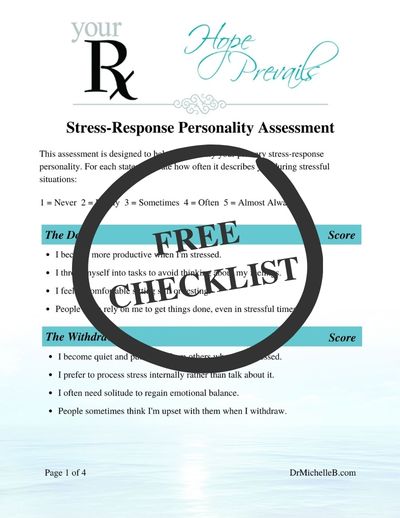
Stress rarely affects everyone the same way. Your brain, body, and emotions often respond in unique patterns shaped by your personality, past experiences, and nervous system.
This assessment will help you identify your primary stress-response personality so you can better understand how you react under pressure, recognize your stress patterns, and begin moving toward healthier, faith-filled responses.
Get the assessment here: Stress-Response Personality Assessment


