

We live in a culture that is remarkably uncomfortable with discomfort. When we’re sad, we want to feel happy. When we’re anxious, we want to feel calm. When we’re overwhelmed, we want the pressure to disappear. When we’re hurting, we want an answer that will make the hurting stop. I’ve been there. There is nothing inherently wrong with wanting relief. If you’ve been carrying too much for too long, of course you want to feel better. If you’ve been waking in the middle of the night worrying about someone you love, of course you want peace. If you’re navigating a difficult season you didn’t choose, of course you want it to end.
But what if feeling better isn’t the only way to know that you’re okay? What if you can be hurting and still be okay? What if you can be anxious and still be safe, disappointed and still have hope, uncertain and still trust God? That doesn’t mean we resign ourselves to suffering or stop pursuing help when we need it. It means we stop making the absence of uncomfortable emotion the requirement for believing that we’re going to be okay.
The Pressure to Feel Better
Sometimes our efforts to manage difficult emotions can unintentionally become another source of stress. We notice anxiety and immediately begin asking, How do I make this stop? We feel sad and wonder, What’s wrong with me? Why am I still feeling this way? We experience fear and conclude, If I really trusted God, I wouldn’t be this afraid. Before long, we’re not only dealing with the original problem. We’re also judging ourselves for how we’re responding to it.
That second layer of distress can be exhausting. Emotions are not moral failures. Feeling anxious doesn’t mean you’ve failed spiritually. Feeling sad doesn’t mean you’ve lost your faith. Feeling overwhelmed doesn’t mean you’re incapable of handling life. Sometimes an emotion is simply information. It may be telling you that something matters, signaling that you’ve exceeded your current capacity, reminding you that you’ve experienced loss, or alerting you to something that needs attention.
And sometimes, particularly when you’ve been under prolonged stress, your emotional response may be stronger than you expected. I’ve written before about why we can feel overwhelmed even when the individual stressors don’t seem that significant. Often, it isn’t one thing. It’s the accumulation of everything we’ve been carrying. That matters because if we misunderstand our distress, we may spend all our energy trying to eliminate the feeling instead of listening to what it is communicating.
Relief and Peace Aren’t Always the Same Thing
There’s an important difference between relief and peace.
Relief says, I need this circumstance to change so I can be okay.
Peace says, I wish this circumstance would change, but I don’t have to have control over the outcome to know that God is with me.
Relief isn’t bad. Sometimes circumstances need to change. Sometimes we need to establish a boundary, leave an unhealthy situation, seek professional help, have a difficult conversation, or make a significant decision. But there will also be circumstances we cannot change. We cannot make another person choose differently. We cannot always prevent loss. We cannot control how quickly a diagnosis changes. We cannot make someone else understand us. We cannot guarantee that our children, spouses, parents, friends, or loved ones will make the choices we wish they would make. We cannot know exactly what tomorrow will bring.
If our ability to be okay depends entirely upon circumstances becoming comfortable, we’re going to spend much of our lives waiting for permission to breathe. There will always be another uncertainty, another disappointment, another relationship we cannot control, or another situation that doesn’t resolve according to our preferred timeline. Learning that we can remain grounded even when circumstances remain unsettled is a different kind of emotional strength.

Sometimes the Goal Is to Become Steady, Not Comfortable
Emotional health doesn’t mean that we never experience difficult emotions. It means we become increasingly able to experience those emotions without being completely controlled by them. You can feel anxious and still make a wise decision. You can feel sad and still get out of bed. You can feel disappointed and still love someone. You can feel angry and still choose not to respond impulsively. You can feel uncertain and still take the next step. You can feel overwhelmed and still ask for help.
That’s different from pretending everything is fine. It’s also different from forcing yourself to “think positive” until the difficult feeling disappears. Sometimes resilience looks much quieter than that. It may simply mean acknowledging, This is hard, and I’m going to take the next right step anyway.
That is an important distinction, especially for those of us who have spent years being responsible, capable, and dependable. When people are accustomed to solving problems, caring for others, and keeping things moving, emotional discomfort can feel like something that needs to be fixed immediately. But not every uncomfortable emotion is a problem that needs to be solved. Sometimes an emotion needs to be acknowledged, understood, and allowed to move through us while we continue making wise choices.
You Don’t Have to Argue with Every Emotion
One of the most helpful things we can learn is that we don’t have to believe every thought or obey every emotion. If anxiety tells you, Something terrible is going to happen, you can notice the thought without treating it as a prophecy. If sadness tells you, Nothing will ever change, you can acknowledge the sadness without accepting hopelessness as fact. If exhaustion tells you, You can’t do one more thing, you can pause long enough to determine whether you truly need rest or whether you’re afraid of what comes next.
This is one reason I’ve written so often about paying attention to our thought patterns. Our thoughts influence our emotions, decisions, and behavior, and learning to recognize thoughts that don’t align with truth can change how we respond to what we’re experiencing. Renewing your mind through Scripture isn’t about pretending difficult things aren’t happening. It’s about learning to distinguish what is true from what fear, discouragement, or exhaustion may be telling us.
You don’t have to fight every emotion, and you don’t have to fix every feeling. Sometimes you simply need to notice it, name it, and decide what you want to do with it. There is freedom in realizing that an emotion can be present without being in charge.
What If God Is Near Even When You Don’t Feel Peaceful?
This is where faith becomes especially important. We sometimes assume that God’s presence should always produce an immediate feeling of peace. Yet Scripture doesn’t promise that following God means we will never feel afraid, grieved, confused, or overwhelmed. The Psalms are filled with people crying out to God from places of fear, grief, confusion, and desperation. Even Jesus wept.
The presence of difficult emotions doesn’t mean the absence of God.
Sometimes we want God to change the circumstance because we believe that will finally allow us to experience His peace. But Scripture repeatedly invites us to discover that He can meet us in the circumstance. I’ve written about finding mental rest when you’re overwhelmed, including the biblical invitation to surrender the mental chaos we cannot resolve and receive God’s rest. I’ve also written about letting go of control and trusting God, because so much of our distress can become entangled with our desire to control how, when, and whether circumstances will change.
Sometimes surrender doesn’t feel peaceful at first. Sometimes surrender feels like unclenching your hands while they’re still shaking. Sometimes faith looks less like I feel completely at peace and more like I don’t understand this, but I’m going to keep trusting God one step at a time. That’s still faith.

You Can Be Okay Without Everything Being Okay
There is a difference between saying, Everything is okay, and saying, I am going to be okay even though everything isn’t okay right now. The first can feel dismissive when life genuinely hurts. The second leaves room for reality and hope to coexist.
Maybe your marriage is struggling, but you are still worthy of love and capable of making wise choices. Maybe you’re worried about your adult child, but you don’t have to spend every waking moment trying to control their outcome. Maybe you’re grieving someone you love, and the grief may not disappear simply because someone tells you to have faith. Maybe you’re facing an uncertain medical or financial situation, and you don’t know how it will turn out. Maybe you’re exhausted from being the strong one for everyone else. Maybe you’re entering a season you didn’t expect and don’t particularly want.
You don’t have to call those circumstances good in order to believe that God is still good. You don’t have to feel happy to have hope. You don’t have to feel peaceful every minute to be held by the Prince of Peace. You don’t have to know what happens next to trust the One who does.
Sometimes “I’m Okay” Means “I’m Not Alone”
Maybe being okay isn’t a feeling at all. Sometimes being okay means knowing that you aren’t carrying this alone. It means you can ask for help without interpreting that need as weakness. It means you can sit with a difficult emotion without immediately trying to outrun it. It means you can seek counseling when your distress becomes more than you can manage on your own. It means you can rest without earning it first. It means you can tell God the truth about how you feel rather than cleaning up your prayers before you bring them to Him.
Sometimes it also means allowing someone who loves you to sit beside you in the middle of something they cannot fix. There are seasons when what we most need isn’t another solution. We need presence. We need someone who isn’t afraid of our tears, who won’t rush us through our grief, and who can remind us of what is true when we can’t quite remember it for ourselves.
And sometimes, we need to remember that God is that kind of presence too.
You Can Take the Next Step Without Knowing How the Story Ends
If you’re waiting to feel better before you move forward, I wonder what might happen if you stopped requiring that of yourself. Not because your feelings don’t matter. They do. Not because you should ignore what hurts. You shouldn’t. And not because you need to settle for suffering. You don’t.
But perhaps you can give yourself permission to take the next step while still feeling unsettled. You can make the phone call while your hands are shaking. You can have the conversation while you’re nervous. You can get out of bed even though the grief is still there. You can ask for help even though you wish you didn’t need it. You can pray even when your prayer is little more than, “Lord, help me.” You can trust God without knowing exactly what He’s going to do.
You can be okay without everything being okay.
Maybe that’s a different kind of comfort altogether. It isn’t the comfort of escaping what hurts. It is the comfort of knowing you don’t have to experience it alone.
If you’re in a season right now where you keep wondering why you aren’t “over it” yet, I hope you’ll be gentle with yourself. Maybe you’re not failing to move forward. Maybe you’re learning how to move forward while carrying something that still hurts. There’s a difference.
And if that’s where you are, I want you to know something I hope you’ll remember long after you close this page: You don’t have to have yourself completely together for God to meet you here. You don’t have to feel better before you are worthy of care. You don’t have to have the answers before you can take the next step. And you don’t have to pretend with me.
Some days faith feels strong. Other days it feels like holding on and whispering, “Jesus, please help me.” I’ve had those days too. So if today is one of them, you don’t have to hide it or apologize for it. Pull up a chair. Take a breath. Let’s not pretend everything is okay when it isn’t. Let’s simply remember together that you can be not okay and still be held.
Sometimes, that is where hope begins.
(If there are affiliate links in this post, meaning, if you click through and make a purchase, I may receive a commission (at no extra cost to you)).
If you need a little encouragement to keep moving forward when life feels hard, Sheila Walsh’s book, It’s Okay Not to Be Okay: Moving Forward One Day at a Time, offers a reminder that you don’t have to have everything figured out to take the next step. And sometimes we need a simple, everyday reminder to give ourselves grace, like this It’s Okay to Not Be Okay trucker hat, which shares a message we all need to remember.
Because of Him, #HopePrevails!
Dr. Michelle
You don't have to feel peaceful every minute to be held by the Prince of Peace. Difficult emotions don't mean you've lost your faith. God is with you, even when life feels uncertain. Share on X You can feel anxious and still make wise decisions. You can feel sad and still have hope. You can feel uncertain and still trust God. You don't have to feel better before taking the next step. Share on X
Get your Free Stress-Response Personality Assessment
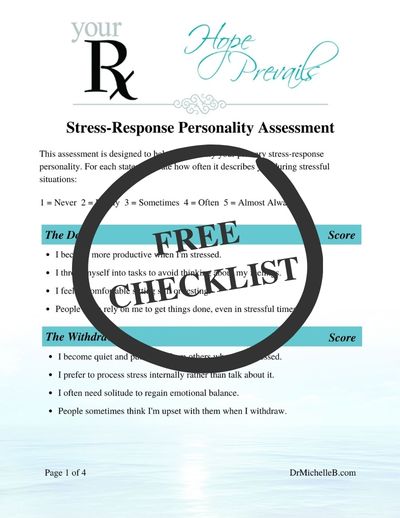
Stress rarely affects everyone the same way. Your brain, body, and emotions often respond in unique patterns shaped by your personality, past experiences, and nervous system.
This assessment will help you identify your primary stress-response personality so you can better understand how you react under pressure, recognize your stress patterns, and begin moving toward healthier, faith-filled responses.
Get the assessment here: Stress-Response Personality Assessment


Dr. Michelle,
Thank you for this post. I so, so, so needed it this morning.
Blessings,
Roberta
Roberta, thanks for taking the time to comment. I’m so glad the Lord led you to read my thoughts here. I hope you find other helpful content in my little corner of the internet.
Hope Prevails,
Dr. Michelle
I just want you to know that I think you wrote this article for me.
It has been said that defining a problem is half of the solution — and you really so clearly defined how I have been feeling and operating. I had specifically asked the Lord what was wrong with me — and your article showed me clearly.
I am in a very difficult passage with life in general, but have struggled more with my psyche and emotions than with the hard stuff of daily living. You have given me a path of hope and encouragement.
Blessings on you today.
Judy,
Thank you for taking the time to comment! What a blessing to know the Lord led you to read this post when you needed it. I’m honored to play just a tiny role in helping you see things more clearly. I hope you’ll be blessed by the other content here.
Hope Prevails,
Dr. Michelle