

Have you ever opened a closet and discovered that you have been keeping things you don’t even remember putting there? Maybe it’s a shirt you haven’t worn in ten years, a box you haven’t opened since your last move, or something you kept because you might need it someday, even though you can’t remember why.
Sometimes our hearts look a little like those closets. We accumulate things without realizing it: a hurtful comment, a betrayal, a disappointment, a regret, a secret, a fear, a resentment we told ourselves we would deal with later, or a moment when someone made us feel insignificant. One thing gets tucked away, then another, and another. Eventually, we become so accustomed to carrying them that we don’t even realize how much weight they add to our lives.
That is the idea behind the term emotional hoarding, a concept explored by author Laurie Davies in her new book, Emotional Hoarding: Letting Go of the Stuff That Keeps You Stuck. Laurie joined me on the Your Hope-Filled Perspective podcast for How to Recognize Hidden Emotional Baggage You Didn’t Know You Were Carrying – Episode 390. We talked about what happens when we accumulate emotional burdens and how we can begin clearing out the things that keep us stuck. I think the concept gives language to something many of us experience but don’t always know how to describe.
What Is Emotional Hoarding?
Emotional hoarding is the accumulation of unresolved emotional experiences that we continue carrying rather than processing and releasing. That might include worry, regret, anger, guilt, bitterness, shame, fear, loneliness, or old wounds. Not every difficult emotion represents emotional hoarding. Feeling angry after being hurt is normal. Grieving a loss is healthy. Remembering something painful doesn’t mean you are stuck. The concern comes when emotional experiences are repeatedly stored away, revisited, protected, or carried forward without being adequately processed and dealt with.
Unlike the clutter in our homes, emotional clutter doesn’t always announce itself. You may look like you are doing just fine. You may be functioning at work, caring for your family, serving at church, showing up for the people you love, and accomplishing everything on your calendar. But underneath all of that, you may still be carrying something that happened years ago. You may have forgiven someone intellectually but still feel the sting of what happened whenever something reminds you of it. You may tell yourself that you’ve moved on yet find yourself replaying the conversation in your mind. You may insist that you aren’t angry anymore, while noticing that the subject still makes your body tense. You may have forgotten the details but still carry the emotional residue.
That’s part of what makes emotional hoarding so difficult to recognize. We don’t always realize what we’re carrying until we notice how heavy we feel.
Why Do We Hold On to Emotional Pain?
I’ve previously written about the psychology behind hoarding physical possessions and the fear, anxiety, and emotional needs that can contribute to it. Emotional hoarding is different, but it raises a similar question: Why can it be so difficult to let go?
Our brains are designed to pay attention to experiences that matter. When something threatens our safety, relationships, identity, or sense of belonging, our brains don’t simply file the experience away as though nothing happened. Emotion influences how memories are encoded and how readily they can be retrieved. That’s one reason emotionally significant experiences can remain surprisingly accessible long after the original event has passed.
Sometimes the brain keeps returning to an experience because it is still trying to make sense of it. What happened? Why did it happen? What could I have done differently? Can I trust this person again? How could I have missed the warning signs? Why wasn’t I enough? Will this happen again? Those questions can become mental loops in which we replay conversations, reconstruct scenes, imagine what we should have said, rehearse what we wish the other person would understand, or revisit what happened hoping that another pass through the memory will finally resolve what still hurts.
But repeatedly thinking about something isn’t necessarily the same thing as processing it. Sometimes we are simply rehearsing the wound.
I’ve written before about what happens when our minds get caught in these cycles. In imaginary conversations in our heads, we can spend hours revisiting situations that are no longer happening in the present while our brains and bodies respond as though we are still engaged in the conflict. The past may be over, but our nervous system doesn’t always know that simply because the calendar says it is.
Emotional Hoarding Can Become Part of Our Identity
One of the more subtle dangers of carrying emotional clutter is that eventually we can begin to organize our identity around it. We may begin to think, “I’m the one who was betrayed,” “I’m the one who was rejected,” “I’m the one who always has to be strong,” “I’m the one who can’t trust anyone,” or “I’m the one who made that terrible mistake.” The experience may have happened to us, but over time it can begin to sound like a definition of us.
There is an important distinction here. What happened to you matters, but what happened to you is not the same thing as who you are. That distinction can become especially important when we have experienced trauma, betrayal, rejection, or significant relational pain. We don’t honor our healing by pretending the experience didn’t matter. We honor our healing by refusing to allow the experience to have the final word about our identity, our future, or our relationship with God.
This doesn’t mean we should rush to put a positive spin on painful experiences. Some things genuinely hurt. Some losses change us. Some betrayals alter the way we see a relationship. Some experiences leave scars. Healing isn’t about denying those realities. It’s about allowing them to become part of our story without allowing them to become the entirety of our story.
Unprocessed Hurt Doesn’t Always Stay Quiet
Emotional pain that remains unaddressed doesn’t necessarily disappear simply because we stop talking about it. Sometimes it comes out sideways. We become disproportionately angry about something relatively small. We withdraw from someone who hasn’t actually hurt us. We become suspicious when someone hasn’t given us a reason to distrust them. We become controlling because uncertainty feels intolerable. We become perfectionistic because failure feels threatening. We become people-pleasers because rejection feels unbearable. Or we become emotionally numb because feeling anything seems too exhausting.
Sometimes we find ourselves reacting to today’s situation with the emotional intensity of yesterday’s wound. The person standing in front of us may have done something relatively minor, but our response seems much larger than the moment would suggest. That doesn’t automatically mean there is some hidden wound underneath every strong emotional response, but it can be worth becoming curious about the connection.
I’ve written about this before in Hurting People, Hurt People, because emotional, behavioral, and spiritual wounds that remain hidden can eventually affect the way we relate to other people. The goal isn’t to shame ourselves for having wounds. The goal is to become honest enough to notice them. What we refuse to acknowledge can continue influencing us from beneath the surface.
Does Letting Go Mean Pretending It Didn’t Happen?
This is where I think Christians sometimes need a more nuanced understanding of healing. Letting go does not mean pretending the offense didn’t happen. It doesn’t mean saying that what someone did was okay. It doesn’t mean forgetting. It doesn’t mean automatically restoring a relationship to the way it was before the injury. And it doesn’t mean ignoring legitimate boundaries or consequences.
Forgiveness and reconciliation are not synonymous. Sometimes forgiveness is an act of releasing the person and the debt we believe they owe us into God’s hands while still recognizing that trust must be rebuilt, boundaries may be necessary, and some relationships may never return to what they once were.
That’s why forgiving what we can’t forget is such an important part of emotional and spiritual healing. We don’t have to forget what happened in order to stop carrying it in the same way. There is a difference between remembering a wound and continuing to live inside it.
That distinction matters because telling someone to “just let it go” can actually create more shame. If letting go were as simple as deciding to stop thinking about something, most of us would have done it already. Emotional healing generally requires something deeper than willpower. It can involve grieving what was lost, acknowledging what happened, understanding how it affected us, establishing appropriate boundaries, challenging distorted beliefs, and gradually learning that the present is not necessarily a repetition of the past.
What If You Don’t Even Know What You’re Carrying?
You don’t have to begin by cleaning out your entire emotional closet. That would probably be overwhelming. Instead, start with curiosity. Where do you notice yourself having a stronger emotional reaction than the current situation seems to warrant? What situations do you repeatedly replay? What subject immediately changes your mood? What person can you think about for five seconds and suddenly feel your body tense? What do you keep telling yourself you are “over” while noticing that it still hurts?
It can also be helpful to ask what you are afraid would happen if you stopped holding onto the hurt? Sometimes emotional burdens remain in place because they seem to serve a purpose. Anger may feel like protection. Resentment may feel like a way of making sure the offense isn’t minimized. Hypervigilance may feel like the only way to prevent another betrayal. Holding onto guilt may feel like a form of accountability. Even when these responses have become painful, they may have developed for understandable reasons.
So perhaps one of the most important questions isn’t simply, “What am I holding onto?” It is, “What have I been carrying because I never knew what else to do with it?”
You don’t have to answer every question today. You don’t have to force yourself to revisit painful experiences before you’re ready. And you don’t have to figure everything out by yourself. Sometimes healing begins simply by bringing what has been hidden into the light.
God Doesn’t Ask Us to Carry Everything We Pick Up
One of the things I appreciate about the picture of emotional hoarding is that it reminds us that just because we have picked something up doesn’t mean we were meant to carry it forever.
We can accumulate burdens without realizing it. But Jesus offers something different. He invites the weary and burdened to come to Him, not because our pain doesn’t matter or because our wounds aren’t real, but because we were never designed to carry every burden alone.
Psalm 55:22 reminds us, “Cast your burden on the LORD, and he will sustain you.”
There is something deeply comforting about that invitation. We don’t have to deny what hurts. We don’t have to minimize what happened. We don’t have to clean ourselves up before coming to God. We can bring Him the cluttered places: the anger, the regret, the fear, the shame, the disappointment, the betrayal, the questions we haven’t been able to answer, and the things we wish had never happened.
We can bring Him what we don’t yet know how to release.

Maybe It’s Time to Make Some Room
When I think about emotional hoarding, I don’t picture a person who is weak, dramatic, or unwilling to move forward. I picture someone who has been carrying something for so long that they forgot what it felt like to live without it.
Maybe that’s you. Maybe there is an emotional burden you’ve been carrying so long that it feels like part of you. Maybe you don’t even know what life would feel like if you weren’t constantly protecting yourself from the possibility of being hurt again. Maybe you’re tired. Maybe you’re ready for something different.
If so, you don’t have to clean out the whole house today. You can start with one drawer. One hurt. One fear. One honest conversation with God. One acknowledgment that says, “Lord, this still hurts, and I don’t want to carry it by myself anymore.”
That is not weakness. It is an invitation to healing.
And if Laurie Davies’ conversation about emotional hoarding has made you realize that there may be more emotional clutter in your heart than you knew, I hope you’ll be gentle with yourself. You don’t have to figure it all out today. You don’t have to rush your healing. You don’t have to pretend you’re fine when something still hurts.
You also don’t have to walk through the process alone.
I’m grateful you’re here, and I’m honored to be part of this conversation with you. Whatever you’re carrying today, I hope you know that you don’t have to carry it by yourself. There is room to be honest about what hurts, room to bring it to God, and room to discover that healing doesn’t require you to erase your story. Sometimes it begins when you finally realize you are allowed to stop carrying what was never meant to be yours forever.
Because of Him,
Hope Prevails!
Dr. Michelle
Emotional hoarding can happen when old hurts, fears, regrets, and resentments are stored instead of processed. What are you carrying that God never intended you to carry forever? Share on X Emotional hoarding can keep yesterday’s wounds influencing today’s thoughts, reactions, and relationships. Healing can begin when you recognize what you’re carrying and bring it to God. Share on X
Get your Free Stress-Response Personality Assessment
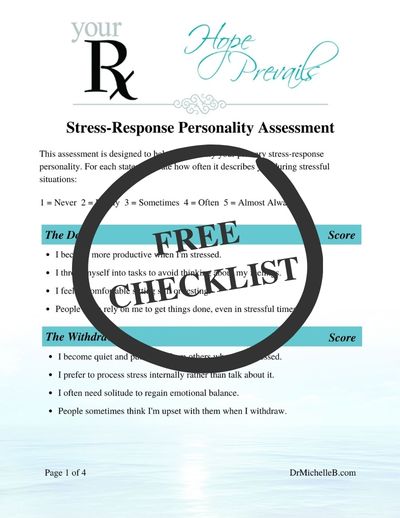
Stress rarely affects everyone the same way. Your brain, body, and emotions often respond in unique patterns shaped by your personality, past experiences, and nervous system.
This assessment will help you identify your primary stress-response personality so you can better understand how you react under pressure, recognize your stress patterns, and begin moving toward healthier, faith-filled responses.
Get the assessment here: Stress-Response Personality Assessment


