

Have you ever noticed that when life feels like too much, you suddenly want something familiar?
Maybe it’s the same meal you’ve ordered a hundred times, the television show you’ve watched so many times you know the dialogue by heart, your favorite sweatshirt, a quiet evening at home, a conversation with the one person who knows you without requiring an explanation, or simply the comfort of being somewhere that feels predictable.
Sometimes, when we’re overwhelmed, we don’t want adventure. We don’t want another decision. We don’t want to learn something new or figure out one more problem. We want what we already know.
And there is a reason for that.
When stress increases, our need for safety, predictability, and emotional regulation increases too. Reaching for something familiar isn’t necessarily a sign that we’re weak, immature, resistant to change, or incapable of handling life. Sometimes it is simply our mind and body looking for something that feels safe when too much around us feels uncertain.
Why Stress Makes Familiar Things Feel So Comforting
Stress requires energy. When demands continue to pile up without sufficient opportunity for recovery, we can become mentally and emotionally depleted. Decision-making becomes harder. Patience gets shorter. Concentration suffers. Even relatively minor problems can begin to feel disproportionately difficult.
I’ve written before about why small stresses can feel overwhelming when we’re already carrying too much. When our capacity is already stretched, the coffee machine breaking or someone asking one more question may not actually be the problem. It may simply be the thing that lands on top of everything else we have been carrying.
In those moments, familiar experiences can require less mental effort. We already know what to expect. There is less uncertainty to navigate and fewer decisions to make. That predictability can feel soothing when the rest of life feels anything but predictable.
Think about what happens when you’ve had an exhausting day. You may not want to try a new restaurant. You may want the meal you know you’ll enjoy. You may not want to watch a complicated movie that requires your full attention. You may want the familiar show you’ve seen before. You may not want to have another difficult conversation. You may simply want to sit beside someone who makes you feel safe.
There is nothing inherently wrong with that.
Sometimes comfort is exactly what we need.
Comfort Is Not the Same as Avoidance
This is where the conversation gets a little more nuanced.
We sometimes talk about comfort as though it is something we should outgrow. We tell ourselves that we need to push through, get over it, stop feeling sorry for ourselves, or simply be stronger.
But comfort and avoidance aren’t the same thing.
Healthy comfort can help us regulate enough to return to what matters. Avoidance keeps us from what matters.
That distinction is important.
Imagine you’ve had a difficult day and you take twenty minutes to sit quietly with a cup of tea, listen to music that settles you, pray, take a walk, or watch something familiar before returning to the responsibilities in front of you. That may be a healthy way of giving yourself a moment to settle.
But if you consistently use comfort to escape every difficult emotion, conversation, responsibility, or uncertainty, the comfort may eventually become part of the problem.
The question isn’t simply, Does this make me feel better?
A better question might be, What happens after I do this?
Does this help me return to my life with greater clarity and steadiness? Or does it make me want to withdraw further from everything that feels difficult?
That distinction can help us move away from shame and toward discernment.
Sometimes What You Call Laziness Is Actually Depletion
There is another reason I want us to be careful about judging ourselves when we reach for comfort.
Sometimes we assume we’re being lazy when we’re actually depleted.
If you’ve been carrying work responsibilities, family concerns, relational tension, financial pressures, health worries, or the needs of people you love, you may reach a point where even ordinary decisions feel exhausting.
That’s not a character flaw.
Chronic stress and mental fatigue can show up as irritability, difficulty concentrating, persistent exhaustion, increased anxiety, withdrawal, and feeling overwhelmed by tasks that normally wouldn’t seem particularly difficult. I’ve written more about these signs in Tools for Managing Chronic Stress and Mental Fatigue.
Sometimes the thing we most need isn’t another productivity strategy.
Sometimes we need recovery.
That may be physical rest. It may be mental rest. It may be emotional rest. And sometimes it may be the simple experience of being somewhere, with someone, or doing something that reminds us we are safe enough to exhale.
Familiarity Can Help Us Regain Our Footing
When everything feels uncertain, familiar routines can provide a sense of stability.
That doesn’t mean we should create a life where nothing ever changes. Life will change. People change. Circumstances change. Seasons change. We cannot protect ourselves from every uncertainty.
But healthy routines can give us anchors within that uncertainty.
Maybe your morning coffee and Scripture reading help you begin the day grounded. Maybe an evening walk helps you transition out of work mode. Maybe calling a trusted friend reminds you that you don’t have to carry everything alone. Maybe sitting in your favorite chair with your Bible at the end of a difficult day gives you a place to be still.
Those things may look ordinary from the outside.
But ordinary doesn’t mean insignificant.
When we’re overwhelmed, small experiences of predictability and connection can create space for us to settle rather than continually operating as though everything is urgent.
This is one reason I continue to talk about the importance of rest. Mental rest when you’re overwhelmed isn’t necessarily about doing nothing. It is about recognizing what kind of rest your mind, body, and emotions actually need.
What Are You Really Craving?
The next time you notice yourself reaching for something familiar when you’re stressed, instead of immediately judging yourself, pause for a moment.
Ask yourself what you’re really looking for.
Connection?
Predictability?
Quiet?
Reassurance?
A break from decision-making?
Permission to stop performing for a little while?
Maybe you’re exhausted from being the person everyone else depends on.
Maybe you’ve spent the entire day anticipating someone else’s needs, solving problems, managing details, and holding things together. By the time evening comes, you don’t want another demand placed on you. You want somewhere to put down what you’ve been carrying.
Maybe what looks like a craving for a familiar television show isn’t really about the show at all.
Maybe you’re craving a few minutes when nobody needs anything from you.
Maybe what looks like wanting to stay home isn’t really about avoiding people.
Maybe you’re longing for a place where you don’t have to explain yourself.
Maybe what looks like wanting your favorite comfort food isn’t really about food.
Maybe you’re simply longing for something in your day to feel uncomplicated.
Those distinctions matter because they help us respond to the need beneath the behavior.

God Meets Us in Our Need for Comfort
There is something else worth remembering when life feels overwhelming: our need for comfort doesn’t surprise God.
Scripture doesn’t tell us to pretend that difficult circumstances don’t hurt. It doesn’t ask us to become emotionally invulnerable. Instead, we repeatedly see God described as our refuge, our shelter, our comforter, and our source of strength.
Jesus Himself invited weary people to come to Him for rest.
That invitation matters because sometimes Christians inadvertently add another burden to an already overwhelmed heart. We may think that if we trusted God enough, we wouldn’t need comfort. If our faith were stronger, perhaps we wouldn’t feel anxious. If we were more spiritually mature, perhaps uncertainty wouldn’t bother us.
But needing comfort isn’t evidence of inadequate faith.
Sometimes it is simply evidence that you’re human.
The question is where we turn for that comfort and whether what we reach for ultimately helps us move toward health, connection, truth, and God, or further away from them.
I’ve written before about finding comfort in times of spiritual distress, because spiritual pain can be complicated. You can love God and still feel distressed. You can trust Him and still feel overwhelmed. You can believe He is near and still have moments when you desperately need reassurance of His presence.
Faith doesn’t require us to deny what we feel.
It gives us somewhere to take what we feel.

You Don’t Have to Be Ashamed of Needing Comfort
Perhaps that’s the part I most want you to remember.
If you’ve been telling yourself that you should be handling things better by now, that you shouldn’t need so much reassurance, that you should be stronger, or that you shouldn’t be this tired, I hope you’ll pause before adding shame to everything else you’re already carrying.
You may not need to try harder.
You may need to listen more carefully to what your exhaustion is telling you.
You may need to recognize that you’ve been operating without enough margin. You may need to let someone help you. You may need to step away for a few minutes without feeling guilty. You may need to admit that something hurts. You may need to rest before you can think clearly about what comes next.
And you may need comfort.
That’s okay.
The goal isn’t to eliminate every difficult emotion or make ourselves so resilient that nothing ever rattles us. The goal is to become increasingly able to recognize what we need, receive healthy comfort, and then reengage with the life God has entrusted to us.
So the next time you find yourself reaching for something familiar after a particularly hard day, you don’t have to immediately criticize yourself for it.
Take a breath.
Pay attention.
Ask what your heart and body might be trying to tell you.
Maybe you don’t need to run away from your life.
Maybe you just need a moment to feel safe enough to stay present in it.
And if you’re the one who is always holding everything together, always remembering what everyone else needs, always being the strong one, I hope you know this: you don’t have to hold it all together here.
You can exhale.
You can be tired.
You can need comfort.
You can bring all of that to God.
And you don’t have to figure out the whole rest of your life today. Sometimes the next faithful step is simply receiving enough comfort and grace for this moment.
I’m right there with you.
Because some days, I need that reminder too.
(If there are affiliate links in this post, meaning, if you click through and make a purchase, I may receive a commission (at no extra cost to you)).
If stress has left you feeling mentally and emotionally exhausted, Barb Roose’s Stronger Than Stress: 10 Spiritual Practices to Win the Battle of Overwhelm offers faith-based encouragement for managing life’s pressures. For those moments when you need to slow down and turn to God for comfort, Tama Fortner’s Prayers for Each Moment offers prayers to help you bring your needs before Him.
Because of Him, #HopePrevails!
Dr. Michelle
Ever wonder why you reach for familiar foods, TV shows, or routines when you're stressed? Familiar things offer predictability when life feels uncertain. Sometimes, comfort is exactly what you need. Share on X What looks like laziness may actually be mental and emotional exhaustion. When stress depletes your energy, you may not need another productivity strategy. You may simply need rest and recovery. Share on X
Get your Free Stress-Response Personality Assessment
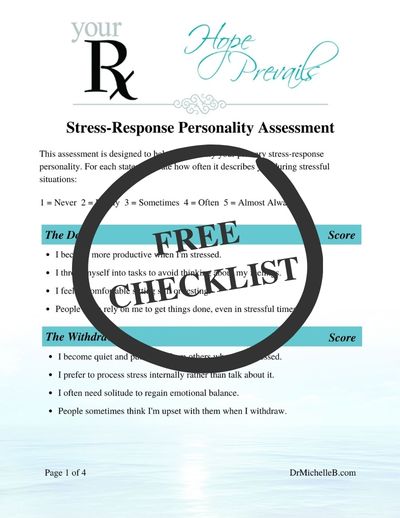
Stress rarely affects everyone the same way. Your brain, body, and emotions often respond in unique patterns shaped by your personality, past experiences, and nervous system.
This assessment will help you identify your primary stress-response personality so you can better understand how you react under pressure, recognize your stress patterns, and begin moving toward healthier, faith-filled responses.
Get the assessment here: Stress-Response Personality Assessment


