

There is a particular kind of exhaustion that doesn’t always look like exhaustion.
You may still be showing up. You answer the phone. You go to work. You remember the appointment. You make the decision. You check on the person who needs checking on. You keep the family moving. You handle the crisis.
From the outside, you may look perfectly capable.
But inside, something has changed.
You stare at a simple task and cannot make yourself begin. You put off the email you would normally answer in five minutes. You find yourself irritated by questions that once wouldn’t have bothered you. You sit down to rest, only to realize you don’t even know how to relax.
And then comes the thought:
What is wrong with me?
Maybe you call it laziness.
You may even find yourself wondering, Why am I feeling so tired and unmotivated when I’m still getting so much done?
But sometimes what looks like laziness is actually depletion.
What happens when you have been carrying too much for too long?
Being responsible can become so familiar that we stop noticing how much responsibility we are carrying.
Perhaps you are supporting a teenager who is struggling, helping an adult child navigate a difficult season, caring for an aging parent, managing the emotional needs of a marriage, working full-time while keeping track of everything happening at home, or simply being the person everyone calls when something goes wrong.
None of those responsibilities is inherently unhealthy.
The problem can arise when responsibility becomes nearly constant and recovery becomes nearly nonexistent.
The brain does not experience every responsibility as a separate, neatly contained event. Keeping track of appointments, anticipating problems, monitoring other people’s emotions, making decisions, solving problems, remembering details, and adjusting to changing demands all consume cognitive resources.
That ongoing mental workload is sometimes called cognitive load.
When demands remain high for a prolonged period, attention can become less efficient. Decision-making can feel harder. Emotional regulation can require more effort. Concentration may become more difficult. Patience may become thinner.
Even motivation can feel different.
That does not necessarily mean you have become lazy.
It may mean your available resources are being consumed faster than they are being restored.
Can chronic stress leave you feeling tired and unmotivated?
Yes, chronic stress can affect far more than whether you feel nervous.
Stress is a physiological response designed to help us respond to demands. In the short term, that response can be adaptive. It helps us mobilize attention and energy when something needs to be handled.
The difficulty comes when significant demands persist without adequate opportunities for recovery.
Over time, sustained stress can contribute to fatigue, sleep disruption, difficulty concentrating, irritability, and reduced emotional capacity. When your brain is continually allocating resources toward what needs attention next, there may be less capacity left for tasks that aren’t urgent.
That can create a frustrating paradox.
You may have enough energy to respond when someone else needs you, but not enough energy to initiate something for yourself.
You may be highly functional in a crisis and strangely unproductive when life finally becomes quiet.
You may be able to spend two hours solving someone else’s problem and then feel incapable of making one more decision for yourself.
That isn’t necessarily a character problem.
It may be a sign that your system has been operating under sustained demand.
Why is being “the strong one” so exhausting?
There is another layer that numbers on a to-do list cannot capture.
Sometimes the greatest burden isn’t what you are doing. It’s what you believe you are not allowed to do.
If you have become accustomed to being the strong one, you may have learned that other people depend on you. You may be the person who stays calm, figures things out, absorbs disappointment, anticipates what might go wrong, and keeps moving when everyone else is overwhelmed.
People may even praise you for it.
“You’re so strong.”
“I don’t know how you do it.”
“We can always count on you.”
Those words are meant as encouragement. But sometimes they can quietly reinforce an identity that leaves little room for being human.
Because what happens when the strong one is the one who needs help?
What happens when the dependable person is emotionally exhausted and depleted?
What happens when the person everyone calls doesn’t have another answer?
There can be a hidden grief in realizing that you have been valued for your strength while privately mourning what that strength has cost you.
Strength is a beautiful quality.
But strength was never meant to mean self-sufficiency.
What if being strong has become so familiar that you no longer know how to be cared for?
This is where depletion can become particularly complicated.
If you have spent years anticipating other people’s needs, receiving care may feel uncomfortable. You may minimize your own exhaustion because someone else has a greater need. You may tell yourself that you’ll rest when everything is finished.
But everything is rarely finished. There is always another email. Another appointment. Another concern. Another person who needs something. Eventually, “I’ll rest when I can” can become a way of life.
And the body and brain don’t necessarily interpret that pattern as strength. They experience ongoing demand without sufficient restoration.
Rest isn’t a reward you receive after proving how much you can endure.
It is part of how human beings recover.
I’ve written elsewhere about the importance of embracing God’s rest, including the reminder that rest is not simply an indulgence but something we can receive rather than continually postpone.
What’s the difference between laziness and emotional exhaustion?
Laziness is a judgment about character. Depletion is a description of capacity. That distinction matters.
If you are feeling depleted, shaming yourself for not accomplishing more doesn’t create the resources necessary to accomplish more. In fact, shame can add another layer of emotional demand to an already overloaded system.
The better question may not be, “Why can’t I make myself do this?”
It may be, “What has been consuming my capacity?”
That question doesn’t excuse every unfinished task. It creates room for curiosity.
Have you been sleeping adequately?
Have demands increased without your noticing?
Have you been carrying emotional responsibility that belongs to more than one person?
Have you had opportunities for genuine recovery?
Have you been grieving something you haven’t had time to acknowledge?
Have you become so accustomed to functioning that you haven’t noticed how tired you actually are?
Those questions can lead somewhere useful.
And sometimes they lead to another important conclusion: persistent exhaustion deserves attention.
Feeling depleted does not automatically mean you are experiencing burnout, depression, anxiety, trauma-related difficulties, ADHD, or another condition. Exhaustion and changes in motivation can have many physical, psychological, and situational causes. If fatigue, changes in sleep, mood, concentration, pleasure, or functioning persist or significantly interfere with daily life, talking with a qualified healthcare or mental-health professional is appropriate.
Understanding is not diagnosis.
It is the beginning of knowing what kind of care may be needed.

What happens when you never allow yourself to need help?
Eventually, the cost may show up in places you didn’t expect:
You may become less patient with people you love.
You may stop enjoying things you once enjoyed.
You may withdraw because conversation itself feels like work.
You may find yourself making decisions based on what will require the least additional energy rather than what you genuinely want.
You may discover that you aren’t necessarily unwilling to engage.
You’re simply tired of carrying.
That realization can be painful.
But it can also be hopeful.
Because if depletion is partly the result of prolonged demand without adequate restoration, then the answer isn’t to become a better version of the person who can carry everything.
The answer may involve carrying less.
That might mean allowing someone else to help. It might mean acknowledging grief. It might mean releasing responsibility for another person’s emotional response. It might mean saying no without writing a three-paragraph explanation. It might mean admitting that something matters deeply to you and you don’t currently have the capacity for it.
And sometimes it means allowing yourself to be cared for before you reach the point of collapse.
Biblical strength isn’t the same as holding everything together
There is a difference between perseverance and perpetual over-functioning.
Scripture doesn’t present strength as the ability to carry every burden without assistance.
Paul wrote about bearing one another’s burdens. Jesus invited the weary to come to Him. Again and again, Scripture points us toward dependence on God rather than toward the illusion that we must manage everything ourselves.
Trusting God does not mean pretending we’re not tired. Faith does not require us to deny our limits. And serving others does not mean accepting every responsibility that comes within our reach. Sometimes faith looks less like trying harder and more like releasing what was never ours to carry.
God’s invitation to rest does not require us to earn the right to be tired first.
Maybe you are not lazy.
Maybe you have been strong for a very long time.
Maybe what you need isn’t another lecture about discipline or motivation.
Maybe you need enough honesty to say, “I’m depleted.”
And then enough grace to let that truth change how you care for yourself, how you receive care from others, and what you are willing to carry next.
Because being strong was never supposed to mean carrying everything alone.
And needing care does not make you weak.
It makes you human.
What People Are Asking about Feeling Tired and Unmotivated
Why do I feel exhausted when I’m doing everything I can?
Prolonged physical, emotional, cognitive, or relational demands can consume more resources than are being restored. You can continue functioning while still becoming increasingly depleted. Persistent or significant exhaustion should also be evaluated for possible physical or mental-health contributors.
Can chronic stress make you feel unmotivated?
It can. Sustained stress can affect attention, sleep, emotional regulation, cognitive efficiency, and energy. When resources are stretched, tasks that are not immediately urgent may feel disproportionately difficult to initiate.
What’s the difference between laziness and emotional exhaustion?
Laziness is a judgment about willingness or character. Emotional exhaustion refers to reduced emotional and cognitive capacity following prolonged demands. Difficulty initiating tasks does not, by itself, tell you why the difficulty is occurring.
Why is being the strong one so exhausting?
Being “the strong one” can involve more than completing tasks. It may include continually anticipating problems, managing other people’s emotions, suppressing your own needs, and feeling responsible for keeping things together. That ongoing responsibility can become exhausting when there is little opportunity for reciprocal care or recovery.
How do you recover from emotional depletion?
Recovery usually involves more than simply taking one day off. It may require reducing unnecessary demands, improving opportunities for sleep and restoration, accepting appropriate support, addressing unresolved emotional burdens, and determining whether an underlying physical or mental-health concern needs professional attention.
What happens when you never allow yourself to need help?
You may become increasingly emotionally exhausted while maintaining the appearance of competence. Over time, this can affect patience, relationships, concentration, enjoyment, motivation, and overall functioning. Learning to receive appropriate support is not a failure of strength. It can be part of sustainable strength.
With God’s help, there is hope! Let Him be the strong One.
Additional Resources:
(If there are affiliate links in this post, meaning, if you click through and make a purchase, I may receive a commission (at no extra cost to you)).
If you’re feeling depleted or emotionally exhausted, you don’t have to keep carrying everything in your own strength. These resources offer additional encouragement for finding strength, peace, and support in difficult seasons. Stronger than Stress: 10 Spiritual Practices to Win the Battle of Overwhelm by Barb Roose offers practical, biblical ways to address stress and overwhelm, while She Believed HE Could, So She Did by Becky Beresford encourages us to trade self-reliance for greater dependence on God. Prayers for Each Moment by Tama Fortner and Desperate Prayers by Rachel Wojo can help when you need words to bring your needs honestly before God. And Stronger Every Day: 9 Tools for an Emotionally Healthy You by Janell Rardon offers practical tools for strengthening your emotional, mental, and spiritual health.
Hope Prevails,
Dr. Michelle
Feeling tired and unmotivated doesn’t always mean you’re lazy. When you’ve been carrying too much for too long, your capacity can become depleted. Maybe what you need isn’t more discipline, but rest. Share on X You can keep showing up for everyone else while feeling tired and unmotivated yourself. Sometimes the problem isn’t laziness. It’s depletion from carrying too much for too long. Share on X
Get your Free Stress-Response Personality Assessment
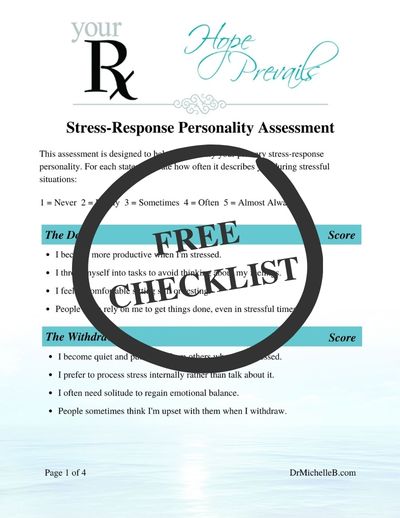
Stress rarely affects everyone the same way. Your brain, body, and emotions often respond in unique patterns shaped by your personality, past experiences, and nervous system.
This assessment will help you identify your primary stress-response personality so you can better understand how you react under pressure, recognize your stress patterns, and begin moving toward healthier, faith-filled responses.
Get the assessment here: Stress-Response Personality Assessment


