
Listen to the podcast below and on your favorite platform or Watch on YouTube:




Episode Summary:
What if the most important thing you prepare your child for this school year isn’t academic success—but emotional resilience? While parents are busy buying school supplies, organizing schedules, and preparing for the first day of class, many children are quietly carrying anxiety, stress, loneliness, pressure, and fear into the new school year.
And if we’re honest, many parents are carrying those same burdens. The truth is that a child’s mental health affects everything—from learning and memory to relationships, confidence, and spiritual well-being. So before the homework starts piling up and the calendar fills to overflowing, let’s talk about how to create a home where every member of the family can thrive emotionally, mentally, and spiritually throughout the school year.
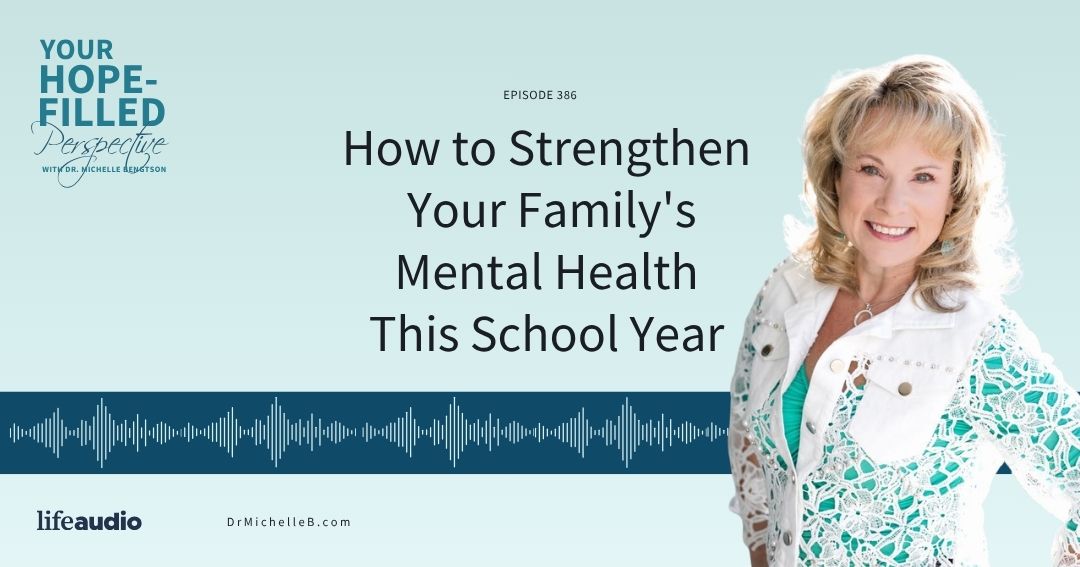
Today we’re talking about something that affects nearly every family this time of year: How to Strengthen Your Family’s Mental Health This School Year.
Quotables from the episode:
- Whether your children are heading to preschool, elementary school, middle school, high school, college, or perhaps you’re a grandparent supporting your grandchildren through another school year, this conversation is for you.
- The beginning of a school year often comes with mixed emotions. There can be excitement, anticipation, and fresh opportunities. But there can also be anxiety, stress, pressure, overwhelm, and uncertainty.
- Many parents focus on school supplies, schedules, transportation, and extracurricular activities. Those things matter. But what often gets overlooked is preparing our children—and ourselves—emotionally, mentally, and spiritually for the year ahead.
- Today I want to share practical strategies, neuroscience insights, biblical encouragement, and simple habits that can help strengthen your family’s mental health throughout the school year.
WHY MENTAL HEALTH MATTERS DURING THE SCHOOL YEAR
- Let’s begin by acknowledging something important.
- The school year places unique demands on every member of the family.
- Children face academic expectations, social challenges, peer pressure, extracurricular demands, and sometimes bullying or feelings of inadequacy.
- Parents face busy schedules, homework battles, transportation logistics, financial pressures, and the emotional burden of helping their children navigate life’s challenges.
- And according to research, anxiety among children and adolescents has risen significantly over the last decade.
- What many people don’t realize is that stress affects more than emotions.
- Stress impacts attention. It affects memory. It influences learning. It changes sleep. It alters relationships. It can even affect physical health.
- As a neuropsychologist, I often explain that the brain functions best when it feels safe.
- When children live in a constant state of stress, their brains devote more resources to survival and fewer resources to learning, problem-solving, and emotional regulation. That’s why strengthening mental health isn’t an optional add-on.
- It’s foundational to helping children thrive academically, socially, emotionally, and spiritually.
- Let’s turn the conversation to discuss practical tips for how to strengthen your family’s mental health this school year:
1. AS A PARENT, START WITH YOUR OWN MENTAL HEALTH
- One of the most important things parents can do for their children is care for their own mental health. I know that may sound surprising. Many parents believe being a good parent means focusing exclusively on their children. But children often absorb the emotional atmosphere of the home.
- If parents are chronically overwhelmed, anxious, irritable, exhausted, or emotionally depleted, children tend to feel it. And not only do they feel it, they replicate it.
- Neuroscience teaches us about emotional contagion. Our nervous systems influence one another. Children often borrow emotional cues from the adults around them.
- When parents remain calm during stressful situations, children learn calmness. When parents model healthy coping skills, children learn resilience. When parents prioritize emotional health, children learn that mental health matters.
- So before focusing exclusively on your child’s well-being, ask yourself:
- How am I doing emotionally?
- Am I getting adequate rest?
- Am I managing stress in healthy ways?
- Am I spending time with God?Am I carrying burdens I was never meant to carry alone?
- Parents often give from an empty cup. But God never intended us to live that way. Jesus Himself regularly withdrew to spend time with the Father. If the Son of God needed time for restoration, surely we do too.
2. CREATE PREDICTABLE RHYTHMS
- One of the greatest gifts you can give your family is predictability. Our brains love predictability because predictability creates safety. When life feels chaotic, the brain remains on high alert. When life feels structured, the brain can relax.
- That doesn’t mean every moment needs to be scheduled. But healthy routines help children know what to expect.
- Consider establishing:
- Consistent wake-up times.
- Consistent bedtimes.
- Family meals.
- Homework routines.
- Technology boundaries.
- Family devotional times.
- Predictable rhythms reduce anxiety because children know what comes next. And here’s something fascinating. Children often complain about rules and routines. But neurologically, they actually benefit from them. Structure provides emotional security. It’s one way we communicate, “You’re safe. We’ve got this. You don’t have to carry adult responsibilities.”
3.PROTECT SLEEP AT ALL COSTS
- If I could give families one neuroscience-based recommendation, it would be this: Protect sleep. Sleep is not a luxury. Sleep is a necessity. During sleep, the brain consolidates memories. It processes emotions. It restores energy. It strengthens attention and learning.
- Lack of sleep can increase anxiety, depression, irritability, impulsivity, and emotional reactivity. Many children begin the school year already sleep-deprived. Then extracurricular activities, homework, social media, and busy schedules make things worse.
- As parents, we need to treat sleep as a priority rather than an afterthought. Consider establishing a calming bedtime routine. Reduce screen exposure before bed. Encourage consistent sleep schedules. And remember that adults need sleep too. Sometimes the healthiest thing you can do for your family is go to bed earlier.
4.TEACH CHILDREN TO TALK ABOUT EMOTIONS
- Many children struggle not because they have emotions but because they don’t know what to do with them. One of the most valuable skills we can teach children is emotional awareness. Help them identify what they’re feeling.
- Instead of saying: “I’m fine.”
- Teach them to recognize:
- “I’m nervous.”
- “I’m disappointed.”
- “I’m embarrassed.”
- “I’m frustrated.”
- “I’m lonely.”
- “I’m overwhelmed.”
- Research consistently shows that naming emotions helps reduce emotional intensity. When children can identify their feelings, they become better equipped to manage them.
- Create opportunities for conversation. Ask questions like:
- “What was the best part of your day?”
- “What was the hardest part?”
- “What made you smile today?”
- “What felt stressful?””What do you need right now?”
- Sometimes children don’t need solutions. Sometimes they simply need a safe place to process.
5.LIMIT THE COMPARISON TRAP
- One of the greatest threats to mental health today is comparison. Children compare grades. Athletic performance. Friendships. Appearance. Popularity. Achievements.
- And unfortunately, social media amplifies comparison like never before.
- Comparison often leads to anxiety, insecurity, jealousy, discouragement, and self-doubt.As parents, we must consistently remind our children that their value comes from who they are, not what they achieve.God never intended your child to become someone else’s child. He created them uniquely. Purposefully. Intentionally. When we help children focus on growth rather than comparison, we nurture healthier self-esteem.
- Remind them often: You don’t have to be the best. You simply need to be faithful with what God has entrusted to you.
6.WATCH FOR WARNING SIGNS
- As parents, we need to remain attentive to changes in behavior. Mental health struggles often reveal themselves through behavior before children have words to explain what they’re experiencing.
- Watch for:
- Changes in sleep.
- Changes in appetite.
- Withdrawal from friends.
- Loss of interest in activities.
- Frequent headaches or stomachaches.
- Declining grades.
- Excessive worry
- Irritability.
- Persistent sadness.
- Perfectionism.
- Avoidance behaviors.
- One difficult day doesn’t necessarily indicate a problem. But persistent changes deserve attention. Trust your instincts. God often gives parents discernment for a reason.
- And remember: seeking support is not a sign of failure. It’s a sign of wisdom.
7. BUILD RESILIENCE, NOT PERFECTION
- Many parents want to protect their children from every hardship. I understand that instinct. But resilience develops when children learn they can survive challenges. The goal isn’t a stress-free life. The goal is learning how to navigate stress in healthy ways.
- Children build resilience when they:
- Solve problems
- Learn from mistakes.
- Experience disappointment.
- Recover from setbacks.
- Develop coping skills.
- Face challenges with support.
- If we remove every obstacle, we unintentionally communicate that they cannot handle difficulty.
- Instead, we can say: “This is hard.”
- “I believe you can get through it.” “I’m here to support you.”Those messages strengthen confidence and resilience.
8. CULTIVATE FAMILY CONNECTION
- One of the strongest protective factors for mental health is connection. Children thrive when they feel known, loved, valued, and connected.
- That doesn’t require extravagant vacations.It often happens through ordinary moments.
- Family dinners.
- Bedtime conversations.
- Car rides.
- Board games.
- Walks together.
- Shared laughter.
- Prayer time.
- Research consistently shows that strong family relationships reduce the risk of anxiety, depression, substance abuse, and other mental health concerns. Connection doesn’t require perfection. It requires presence. Children spell love T-I-M-E.
9. CREATE HEALTHY TECHNOLOGY BOUNDARIES
- Technology is neither entirely good nor entirely bad. But without boundaries, it can negatively impact mental health.
- Excessive screen use has been associated with increased anxiety, decreased sleep quality, reduced attention, and social difficulties.
- Consider creating technology-free zones:
- Technology-free meals.
- Technology-free bedrooms.
- Technology-free family time.
- The goal isn’t punishment.The goal is protecting what matters most.
- Healthy relationships will always nourish mental health more than endless scrolling.
10. MAKE FAITH PART OF EVERYDAY LIFE
- One of the greatest gifts we can give our children is teaching them where to turn when life feels overwhelming.
- The world teaches self-reliance.
- Scripture teaches God-reliance.When children experience anxiety, help them pray.
- When they face disappointment, help them seek God’s perspective.When they’re afraid, remind them of God’s promises.
- Faith is not merely something we practice on Sundays. It’s a source of strength for everyday life. Children need to see faith lived out in real time. They need to see us pray when we’re worried. Trust God when we’re uncertain. Seek wisdom when we’re confused. Depend on Him when we’re overwhelmed
- Faith becomes contagious when it’s authentic.
11.TEACH CHILDREN HEALTHY COPING SKILLS
- Every child needs a toolbox for managing stress.
- That toolbox may include:
- Prayer.
- Scripture meditation.
- Physical activity.
- Journaling.
- Creative expression.
- Deep breathing.
- Worship music.
- Talking with trusted adults
- Time outdoors.
- Gratitude practices.
- These habits help regulate emotions and strengthen resilience. The earlier children learn healthy coping skills, the more equipped they’ll be to navigate future challenges.
12.GIVE GRACE DURING TRANSITIONS
- Transitions are stressful, even positive ones.
- A new grade.
- New teachers.
- New friendships.
- New schedules.
- New expectations.
- Children often need time to adjust.
- Parents do too.
- If your family feels a little off during the first several weeks of school, that doesn’t mean you’re failing. It means you’re adjusting. Give yourself grace.
- Give your children grace.
- Allow room for imperfection. Growth takes time. Adjustment takes time. Healing takes time. Learning takes time. God works in process.
A FINAL WORD OF ENCOURAGEMENT
- Before we close, I want to speak directly to the parent who feels overwhelmed. Maybe you’re worried about your child’s anxiety. Maybe you’re navigating learning differences. Maybe your child has struggled emotionally before.
- Maybe you’re carrying fears about the year ahead.Friend, you do not have to carry those burdens alone. God loves your children even more than you do. He sees every challenge. Every tear. Every fear. Every struggle.
- And He is present in every moment.You are not called to be a perfect parent. You are called to be a faithful one. A parent who loves. A parent who listens. A parent who points their children toward Christ. A parent who keeps showing up. That is enough. God’s grace fills the gaps where our strength ends.
- And remember: circumstances may feel uncertain, challenges may arise, and life may not unfold exactly as planned—but your hope is never based on your circumstances.
- tYour hope is anchored in Christ
Recommended Resources: (If there are affiliate links in this post, meaning, if you click through and make a purchase, I may receive a commission (at no extra cost to you)).
- Stress-Response Personality Assessment
- Sacred Scars: Resting in God’s Promise That Your Past Is Not Wasted by Dr. Michelle Bengtson
- The Hem of His Garment: Reaching Out To God When Pain Overwhelms by Dr. Michelle Bengtson, winner AWSA 2024 Golden Scroll Christian Living Book of the Year and the 2024 Christian Literary Awards Reader’s Choice Award in the Christian Living and Non-Fiction categories
- YouVersion 5-Day Devotional Reaching Out To God When Pain Overwhelms
- Today is Going to be a Good Day: 90 Promises from God to Start Your Day Off Right by Dr. Michelle Bengtson, AWSA Member of the Year, winner of the AWSA 2023 Inspirational Gift Book of the Year Award, the 2024 Christian Literary Awards Reader’s Choice Award in the Devotional category, the 2023 Christian Literary Awards Reader’s Choice Award in four categories, and the Christian Literary Awards Henri Award for Devotionals
- YouVersion Devotional, Today is Going to be a Good Day version 1
- YouVersion Devotional, Today is Going to be a Good Day version 2
- Revive & Thrive Women’s Online Conference
- Revive & Thrive Summit 2
- Breaking Anxiety’s Grip: How to Reclaim the Peace God Promises by Dr. Michelle Bengtson, winner of the AWSA 2020 Best Christian Living Book First Place, the first place winner for the Best Christian Living Book, the 2020 Carolina Christian Writer’s Conference Contest winner for nonfiction, and winner of the 2021 Christian Literary Award’s Reader’s Choice Award in all four categories for which it was nominated (Non-Fiction Victorious Living, Christian Living Day By Day, Inspirational Breaking Free and Testimonial Justified by Grace categories.)
- YouVersion Bible Reading Plan for Breaking Anxiety’s Grip
- Breaking Anxiety’s Grip Free Study Guide
- Free PDF Resource: How to Fight Fearful/Anxious Thoughts and Win
- Hope Prevails: Insights from a Doctor’s Personal Journey Through Depression by Dr. Michelle Bengtson, winner of the Christian Literary Award Henri and Reader’s Choice Award
- Hope Prevails Bible Study by Dr. Michelle Bengtson, winner of the Christian Literary Award Reader’s Choice Award
Children don’t always have the words to tell us when something is wrong. Learn what changes in behavior may signal a mental health concern and how to create a safe place for your child to talk about what they’re experiencing. Share on X Your child needs more than academic preparation for the school year ahead. Learn practical ways to strengthen family connection, establish healthy technology boundaries, manage stress, and make faith part of everyday life. Share on X
Social Media Links for Host:
For more hope, stay connected with Dr. Bengtson at:
Order Book Sacred Scars / Order book The Hem of His Garment / Order book Today is Going to be a Good Day / Order Book Breaking Anxiety’s Grip / Order Book Hope Prevails / Order Book Hope Prevails Bible Study / Website / Blog / Facebook / Twitter (@DrMBengtson) / LinkedIn / Instagram / Pinterest / YouTube / Podcast on Apple
Hosted By: Dr. Michelle Bengtson
Audio Technical Support: Ashton Bengtson


