

There is a particular kind of exhaustion that can come after a crisis.
You made it through. You kept going. You learned what you needed to learn, did what you needed to do, and somehow found your way to a place where life is no longer quite as dangerous, painful, or uncertain as it once was.
And yet, something still feels different.
Survival mode after trauma can continue even when the danger has passed. You may be safe, but you don’t feel settled. You may be functioning, but you don’t feel fully present. You may even find yourself wondering why it is so difficult to relax, trust, enjoy good things, or imagine a future without immediately looking for what could go wrong.
Sometimes the reason is that your brain became very good at surviving.
That isn’t a criticism. It may have been exactly what you needed.
But surviving and living are not quite the same neurological assignment.
What happens to the brain in survival mode after trauma?
The brain is designed to learn from experience, especially experiences that involve danger. When something threatening happens, the brain doesn’t simply record the event as a story from the past. It also learns associations that may help you recognize and respond to danger in the future.
That learning is protective.
If a particular situation, place, sound, expression, or circumstance preceded danger, your brain may become more attentive to similar cues later. Research into threat learning shows how the brain forms, stores, and updates associations involving danger and safety.
For someone who has experienced profound trauma, that learning can become particularly important. The brain may become highly efficient at scanning for threat, anticipating what could happen next, and preparing for the possibility of danger.
This is part of what we often describe as survival mode after trauma. Your brain has learned to prioritize protection, remaining alert to anything that might signal that danger is coming again.
And that makes sense.
A brain that has learned, “Pay attention. This matters. You need to be ready,” isn’t malfunctioning simply because it learned that lesson.
The difficulty comes when the circumstances change but the brain has not yet had enough new experiences to update what it has learned.
That doesn’t happen identically for everyone, and experiencing trauma does not mean a person will develop PTSD. In fact, most people exposed to traumatic events do not develop PTSD.
But for some people, symptoms such as hypervigilance, avoidance, emotional numbing, intrusive memories, or exaggerated startle can persist long after the original event. These responses reflect complex interactions among learning, memory, threat detection, context, and emotional regulation.
Understanding that distinction matters.
You are not necessarily “choosing” to remain stuck.
Your brain may still be protecting you according to what it learned before.
Why can you feel safe and still have trouble feeling safe?
One of the most important things to understand about trauma and prolonged stress is that knowing something intellectually and experiencing it physiologically are not always the same thing.
You can tell yourself, “I’m safe now.”
You can know that the situation has changed.
You can look around your current circumstances and recognize that the danger is no longer present.
And still find yourself tense, guarded, startled, avoidant, or unable to fully relax.
The brain has to learn from experience, not simply from information.
This is one reason recovery is not merely a matter of telling yourself to “move on.”
Threat learning can become associated with particular cues and contexts. Recovery involves new learning that can coexist with, and sometimes compete with, what was learned during the threatening experience. Research on fear and safety learning describes this as an ongoing process of updating associations, rather than simply erasing an old memory.
That is an important distinction.
Healing does not require you to forget what happened. It means your past experience can become part of your story without having to remain the primary predictor of what happens next.
Can your brain learn something different after trauma?
Yes, although “rewiring” is often used too casually.
The brain remains capable of change throughout life. Experiences, learning, relationships, behaviors, and therapeutic interventions can influence neural functioning and patterns of response. That capacity for adaptation is one reason there is legitimate hope for recovery.
But neuroplasticity is not a magic eraser.
You cannot simply think differently and command a traumatic memory to disappear. You cannot force yourself to feel safe before your brain and body are ready. And healing doesn’t happen on a predetermined timetable.
Instead, new learning can gradually become possible.
A person may begin to discover, sometimes in very small ways, “I experienced that feeling, and I survived it.”
“I noticed the trigger, and I had a choice.”
“I was vulnerable, and someone responded with kindness.”
“I rested, and nothing terrible happened.”
“I experienced joy without something bad immediately following.”
“I can remember what happened without being completely transported back into it.”
Those experiences matter because they provide the brain with new information.
They don’t erase the old learning. They add to it.
For a deeper look at the relationship between trauma, stress, and brain change, you can also read about rewiring the brain after trauma and stress. That process is not about pretending the past didn’t happen. It is about creating room for new patterns of response.
What does it mean to move from surviving to living?
Moving from survival to living does not mean becoming carefree. It does not mean that you never feel afraid again. And it certainly does not mean that you should stop taking reasonable precautions simply because you want to feel better.
It means your life gradually becomes larger than your protection strategies.
Survival tends to narrow our attention toward what is necessary to get through the moment. Living allows room for things that aren’t strictly necessary for survival but are deeply important to being human: connection, curiosity, creativity, pleasure, purpose, rest, laughter, trust, and hope.
Sometimes that transition begins with something surprisingly simple: noticing what still feels difficult.
Maybe you have become accustomed to staying busy because stillness gives your thoughts too much room.
Maybe you automatically anticipate problems because preparation once made you feel safer.
Maybe receiving kindness feels more uncomfortable than giving it.
Maybe you have become so accustomed to managing everyone else’s needs that you no longer know what brings you joy.
Maybe you have learned to avoid anything that could make you vulnerable to disappointment again.
None of these responses should automatically be labeled pathological. Many developed for understandable reasons.
But they are worth noticing.
Sometimes the question is not, “What’s wrong with me?”
A more useful question may be, “What did I learn I needed to do to survive, and is that strategy still serving me now?”
That kind of curiosity can open a door that shame keeps closed.
Why does hope sometimes feel vulnerable after deep hurt?
After profound hurt, hope can feel dangerous.
If you once believed something would be safe and it wasn’t, or trusted someone and were deeply betrayed, or expected life to unfold in a particular way and it didn’t, your brain may become understandably cautious about investing in another future.
Hope requires some willingness to move toward something you cannot completely control.
That can feel vulnerable when control once seemed necessary for safety.
But hope is not the same as certainty.
Christian faith doesn’t require us to pretend that what happened was good or that we know exactly why it happened. Scripture gives us permission to lament, to grieve, and to bring our deepest pain honestly before God.
Psalm 34:18 says, “The Lord is close to the brokenhearted.”
That is a different kind of promise than, “Nothing painful will ever happen again.”
It is the promise of God’s presence.
And sometimes that is where hope begins again: not with certainty about the future, but with the growing recognition that you do not have to face the future alone.

What helps the brain move toward living again?
There is no single formula for recovery from trauma or profound adversity. The appropriate path depends on what happened, what responses remain, what resources are available, and whether there is ongoing risk of danger or harm.
For some people, professional trauma treatment is an important part of healing. For others, supportive relationships, healthy routines, spiritual practices, meaningful activity, and time may all play a role.
What matters is that you don’t confuse healing with forcing yourself to be okay.
Sometimes moving forward looks less like pushing yourself into a new life and more like slowly expanding the life you already have.
You take a walk because you want to notice the trees, not because you need to accomplish something.
You laugh without immediately feeling guilty for enjoying yourself.
You let someone trustworthy know what you’re really feeling.
You practice resting without treating rest as laziness.
You allow yourself to imagine that something good might happen without demanding a guarantee that it will.
These may look like small things.
Neurologically and emotionally, they can represent something much larger: new experiences that tell your brain there is more to your life than what happened to you.
If you are carrying the effects of chronic stress as well as trauma, you may also benefit from understanding how chronic stress and mental fatigue can affect concentration, emotional regulation, resilience, and even our sense of spiritual connection.
And if emotional pain itself has become something you are trying desperately to avoid, it may help to consider how to deal with emotional pain without minimizing what you have experienced.
Living again doesn’t mean going back to who you were
This may be the part we misunderstand most.
After deep hurt, the goal isn’t necessarily to become the person you were before.
You may be more discerning now.
You may recognize boundaries you didn’t recognize before.
You may understand your own needs differently.
You may carry scars that will always remind you of what happened.
Healing doesn’t require returning to an untouched version of yourself. It can mean becoming someone who knows that pain is real and still makes room for joy. Someone who remembers what happened and can still look toward what might happen. Someone who has learned that vigilance can protect you, but it doesn’t have to become the organizing principle of your entire life.
Your brain learned what it needed to survive. With time, appropriate support, and new experiences, it can also learn that survival is not the only thing life has to offer.
And perhaps that is one of the quietest forms of hope: realizing that what happened to you may always be part of your story, but it does not have to be the only story your brain knows how to tell.

What People Are Asking About Survival Mode After Trauma?
Can your brain really learn to feel safe again after trauma?
Yes. The brain remains capable of learning and adapting. Recovery can involve developing new associations with safety and learning different ways to respond to reminders of past danger. The process varies considerably from person to person and is not the same as erasing traumatic memories.
Why do I still feel on edge when I’m no longer in danger?
After trauma or prolonged threat, the brain may continue responding strongly to cues associated with danger. This can happen because threat learning involves associations among memories, contexts, sensations, and expectations. Persistent symptoms can sometimes be part of PTSD, but not everyone who experiences trauma develops PTSD.
Does healing from trauma mean forgetting what happened?
No. Healthy recovery does not require forgetting or minimizing what happened. It involves developing the capacity to remember the experience while also recognizing the distinction between the past and the present and responding to current circumstances with greater flexibility.
Why can happiness feel uncomfortable after trauma?
If your brain has become accustomed to anticipating danger, positive experiences may initially feel unfamiliar or vulnerable. This does not mean you are incapable of happiness. It may simply take time and repeated experiences of safety for your brain to become more comfortable with a life that contains pleasure as well as protection.
How do I know when I need professional help?
If trauma-related symptoms are persistent, interfere with sleep, relationships, work, daily functioning, or your ability to feel safe, professional evaluation can be appropriate. Persistent symptoms such as intrusive memories, avoidance, significant hyperarousal, emotional numbing, or severe distress deserve attention rather than shame.
Can faith and trauma recovery coexist?
Absolutely. Faith does not require you to deny psychological or physiological responses to trauma. Christian faith can provide meaning, relationship with God, community, lament, and hope while evidence-based mental-health care addresses the effects of trauma on thoughts, emotions, behavior, and the nervous system.
Maybe you’ve spent so long learning how to survive that you aren’t quite sure what it means to live again.
If that’s where you are, I hope you’ll be gentle with yourself. You don’t have to rush into a life that feels unfamiliar just because the crisis has passed. You don’t have to prove that you’re healed. And you don’t have to pretend that what happened didn’t change you.
You can take the next small step when you’re ready. You can let yourself notice what feels safe. You can receive a moment of joy without wondering when it will disappear. You can begin to imagine that there might still be something ahead of you worth looking toward.
The life you’re rebuilding may not look like the life you once imagined. But that doesn’t mean it can’t still be deeply meaningful.
And if you’re still learning how to live after everything you’ve survived, please know this: you don’t have to have it all figured out before you begin again.
(If there are affiliate links in this post, meaning, if you click through and make a purchase, I may receive a commission (at no extra cost to you)).
If you’d like additional encouragement and support as you move from surviving to living again, Healing from Life’s Deepest Hurts: Reclaiming Your Life After Grief, Loss, or Trauma by Kimberly Haar and Set Free, Released from the Damage of Trauma by Dr. J. Otis Ledbetter offer further insights for healing from the effects of trauma and deep hurt. Both can be helpful companions as you continue taking steps toward healing, hope, and a fuller life.
Hope Prevails,
Dr. Michelle
You survived the trauma, but your brain may still be watching for danger. Survival mode after trauma can linger even when life is safer. The good news? Your brain can learn from new experiences, too. Share on X Why is it hard to relax when the danger has passed? Your brain may still respond to what it learned during trauma. Healing helps your brain learn that the past doesn’t have to predict what comes next. Share on X
Get your Free Stress-Response Personality Assessment
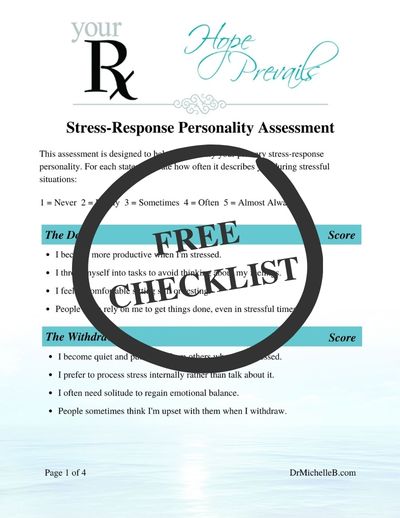
Stress rarely affects everyone the same way. Your brain, body, and emotions often respond in unique patterns shaped by your personality, past experiences, and nervous system.
This assessment will help you identify your primary stress-response personality so you can better understand how you react under pressure, recognize your stress patterns, and begin moving toward healthier, faith-filled responses.
Get the assessment here: Stress-Response Personality Assessment


