

Have you ever known exactly what you should be thinking, yet still felt overwhelmed?
You know God is faithful, but you still feel afraid.
You know the situation is temporary, but your mind keeps rehearsing what could go wrong.
You know you need to let it go, but the same thoughts keep circling.
You may even tell yourself, “I just need to stop thinking about it.” Then you feel frustrated because you know better.
But knowing better and feeling differently are not always the same thing.
When you’re experiencing emotional overload, the problem may not be that you haven’t found the right thought yet. Your brain may simply be trying to process more emotional information than it can comfortably manage at that moment. Understanding the neuroscience of overwhelm can help explain why a situation that seems manageable one day can feel completely unmanageable the next.
That distinction matters because it changes the question from “What is wrong with me that I can’t get myself together?” to “What is my brain and nervous system needing right now?”
Why Thinking Isn’t Always Enough
Our thoughts matter. What we think influences how we interpret circumstances, where we direct our attention, and how we respond to what happens around us. That is one reason Scripture tells us to be transformed by the renewing of our minds (Romans 12:2).
But the brain is not simply a thinking machine. Your emotional experiences involve interconnected systems that communicate continuously. Your brain is processing what you are thinking, what you are feeling, what is happening in your body, what you remember from the past, and what you anticipate might happen next.
When the emotional demands become too great, simply telling yourself to “think positive” can feel like trying to reorganize a room while someone keeps bringing more boxes through the door. You may intellectually understand that you are safe while your body remains tense. You may recognize that your fear is disproportionate to the situation while your heart still races, or know that you need to rest while your mind refuses to slow down.
That doesn’t mean your thinking is powerless. It means thinking is only one part of the equation.

Emotional Overload Can Narrow Your Thinking
When we become overwhelmed, our mental bandwidth changes. The brain prioritizes what seems most urgent, which can make it harder to hold multiple perspectives in mind, shift attention, make decisions, regulate emotions, or access the same level of cognitive flexibility you have when you are rested and regulated.
This is one reason a problem can seem completely manageable in the morning and impossibly complicated late at night. The circumstances may not have changed. Your available cognitive resources have.
Your brain also has limits. When you’re juggling multiple demands, decisions, responsibilities, and emotional concerns, even relatively minor stressors can begin to feel disproportionately difficult. That’s part of what makes emotional overload so confusing. You may wonder why the small thing that happened today bothered you so much when you’ve handled much bigger things before.
Sometimes it isn’t about the size of today’s problem. It’s about how much you’ve already been carrying.
When your brain is already working hard to manage emotional demands, asking it to generate another perfectly rational thought may not be the most helpful first step.
Sometimes the first need is not another thought. It is recovery.
Your Nervous System Is Part of the Conversation
We sometimes talk about emotions as though they exist entirely in our heads. But emotional experiences are embodied. You might notice your shoulders tightening when you anticipate a difficult conversation, your stomach churning before an appointment, or your breathing becoming shallow when you feel threatened. You might feel restless, exhausted, tense, or unable to settle even when you desperately want to relax.
These experiences don’t mean that every physical sensation is caused by emotional distress. Physical symptoms deserve appropriate medical attention, especially when they are new, severe, persistent, or concerning. But it is also true that your brain and body communicate constantly.
That is why emotional regulation is not simply a matter of arguing with yourself until you feel better. Sometimes your nervous system needs an experience of safety, not merely an explanation of safety.
That might mean stepping away from stimulation, slowing your breathing, taking a walk, talking with someone safe, getting adequate sleep, praying, or simply allowing yourself to stop producing for a few minutes. The goal isn’t to escape your emotions. It is to create enough space that you can actually process them.
And sometimes what you need isn’t simply physical sleep. You may need mental rest when you’re overwhelmed, emotional rest, or a break from the constant demand to figure everything out.
You May Need to Feel Before You Can Reframe
There is a difference between being controlled by an emotion and acknowledging that you are experiencing one.
“I shouldn’t feel this way” is not the same thing as “I am feeling this way, and I can bring this feeling to God.” The first response can create another layer of internal conflict. Now you’re not only overwhelmed. You’re judging yourself for being overwhelmed.
The second response creates room. You can acknowledge fear without agreeing with everything fear tells you. You can acknowledge sadness without deciding that sadness will last forever. You can acknowledge anger without allowing anger to determine your behavior. You can acknowledge exhaustion without interpreting it as weakness.
And you can acknowledge that something hurts without believing that God has abandoned you in the pain.
Sometimes emotional processing begins with simply telling the truth about what you are experiencing. That kind of honesty isn’t a failure of faith. It can be an expression of faith.
It also means we don’t have to treat every difficult thought as something we must immediately defeat. There is a difference between noticing a thought, evaluating whether it is true, and becoming consumed by it. Learning to stop overthinking and start trusting can help interrupt the cycle of repeatedly analyzing something that isn’t becoming clearer through more analysis.
What If You Stopped Trying to Fix Yourself?
When we’re emotionally overloaded, we often respond by adding more effort. We read another book, make another plan, analyze the situation one more time, listen to another podcast, try harder to pray correctly, tell ourselves to be grateful, or tell ourselves to stop worrying.
But there comes a point when more input isn’t necessarily more helpful.
Your brain needs periods when it isn’t solving, analyzing, anticipating, producing, or responding. Rest isn’t simply what happens after you’ve finished everything. It is part of how we were designed to live.
Sometimes we assume that if we could just think through the problem one more time, we would finally arrive at peace. But overthinking can become another form of emotional labor. The mind keeps searching for certainty, reassurance, or control, while the person becomes increasingly exhausted.
Sometimes the most spiritually mature thing you can do is stop trying to carry what God never asked you to carry alone (1 Peter 5:7).
Jesus didn’t model constant productivity. He withdrew from the crowds. He prayed. He rested. Rest doesn’t mean nothing is happening. Sometimes restoration is happening beneath the surface.

What You Can Do When You’re Emotionally Overloaded
When you recognize that you’re overwhelmed, instead of immediately asking, “What should I think?” try asking a few different questions: What am I feeling right now? What has my brain been trying to manage? What does my body seem to need? What can wait? What is actually mine to carry today?
You might discover that what you need isn’t another solution. Maybe you need to step away from the noise. Maybe you need to sleep. Maybe you need to talk with someone you trust. Maybe you need to acknowledge an emotion you’ve been trying not to feel. Maybe you need to pray without trying to make your prayer sound more faithful than you actually feel.
And perhaps most importantly, what would it look like to bring this honestly before God rather than trying to manage it perfectly on your own?
That doesn’t mean we abandon the importance of renewing your mind. Renewing your mind is a biblical and important part of emotional and spiritual growth. But renewing your mind isn’t the same thing as demanding that yourself feel better instantly. It is an ongoing process of bringing your thoughts, beliefs, emotions, and responses increasingly into alignment with God’s truth.
If your mind is racing with fear, you might also benefit from learning practical ways to address fearful thoughts. The goal isn’t to eliminate every difficult thought. The goal is to become less governed by those thoughts.
Sometimes that happens through cognitive reframing. Sometimes through grounding. Sometimes through connection. Sometimes through sleep, movement, nourishment, boundaries, prayer, or quiet. Often, it happens through a combination of these things.
And if emotional overload has become persistent enough that it interferes with your daily life, relationships, sleep, or ability to function, it may be time to reach out for additional support. Needing help isn’t evidence that you have failed to think positively enough or trust God deeply enough. Sometimes wisdom looks like recognizing that you don’t have to navigate a difficult season alone.
You Don’t Have to Think Your Way Back to Peace
There is something deeply compassionate about understanding that your struggle isn’t necessarily evidence that you’re doing something wrong. You may simply be carrying more than your mind and body were designed to carry without adequate recovery.
That doesn’t mean you are broken. It doesn’t mean your faith is weak. And it doesn’t mean you need to find the perfect thought that will make everything feel better.
Your thoughts matter.
Your emotions matter.
Your body matters.
Your relationships matter.
And your relationship with God matters.
You don’t have to choose between neuroscience and faith to care for yourself well.
Sometimes renewing your mind means changing what you think. Sometimes it means giving your mind permission to rest. Sometimes it means acknowledging what hurts instead of rushing past it. And sometimes it means becoming quiet enough to remember that you were never meant to carry everything by yourself.
If you’ve been trying desperately to think your way out of what you’re feeling, perhaps today you could offer yourself a little more compassion. Instead of asking, “Why can’t I get over this?” you might ask, “What would help me take the next step?”
You don’t have to have the whole thing figured out today. You can take the next breath, the next moment, the next small step. And perhaps, in that space, you’ll discover that peace doesn’t always arrive because you finally found the right words to tell yourself.
Sometimes peace begins when you stop fighting yourself long enough to receive what you need.
And God is still there, meeting you in that place.
(If there are affiliate links in this post, meaning, if you click through and make a purchase, I may receive a commission (at no extra cost to you)).
Listen to the recent podcast episode with Dr. Michelle and Holly: How to Improve Your Gut Health to Support Your Emotional Health.
If you’d like to go further in understanding how stress, emotional overload, and the things we carry can affect our well-being, Holly Andrews’ Heal Your Stress from the Inside Out, Shemane Nugent’s Abundantly Well: Bible-based Wisdom for Weight Loss, Increased Energy, and Vibrant Health, and Laurie Davies’ Emotional Hoarding: Letting Go of the Stuff That Keeps You Stuck offer additional practical encouragement.
Hope Prevails,
Dr. Michelle
Emotional overload isn’t always something you can think your way out of. Sometimes your brain needs less input, more rest, and space to recover. Share on X Sometimes the answer to emotional overload isn’t another thought. Your brain may need rest, quiet, connection, movement, prayer, or simply space to process. Share on X
Get your Free Stress-Response Personality Assessment
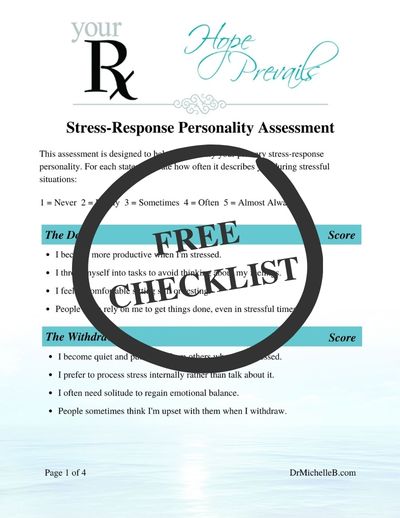
Stress rarely affects everyone the same way. Your brain, body, and emotions often respond in unique patterns shaped by your personality, past experiences, and nervous system.
This assessment will help you identify your primary stress-response personality so you can better understand how you react under pressure, recognize your stress patterns, and begin moving toward healthier, faith-filled responses.
Get the assessment here: Stress-Response Personality Assessment


