

Have you ever wondered if what feels like a spiritual struggle could actually be connected to what’s happening in your body? My friend and recent podcast guest, Holly Andrews, shares what may be happening when burnout feels spiritual and how chronic stress can affect your body, brain, and faith.
When Burnout Feels Spiritual: How Chronic Stress Affects Your Body, Brain, and Faith
by Holly Andrews
Many Christian women I work with quietly wrestle with this question:
What if my exhaustion isn’t just physical?
If you’re a woman who loves God deeply, shows up faithfully in your career, serves your family and church wholeheartedly, and still feels bone-deep tired — this is for you.
You may look composed on the outside.
Capable. Strong. Responsible.
But inside?
You’re running on fumes.
You wake up tired.
You rely on caffeine to function.
Your mind feels foggy.
Your body feels inflamed or unpredictable.
Your prayers feel… hollow.
And somewhere in the quiet of your heart, you wonder:
“Where is God in all of this?”
Or maybe even:
“Is He trying to get my attention?”
Let’s unpack what might actually be happening.
Burnout Is Not a Spiritual Failure
Many Christian women assume that if they just prayed more, had stronger faith, or trusted God better, they wouldn’t feel this way.
But chronic stress is not a character flaw.
It’s not weak faith.
It’s not God being disappointed in you.
It’s physiology.
When your body lives in a constant state of pressure — deadlines, caregiving, leadership, ministry, expectations — your nervous system stays in survival mode.
And survival mode elevates cortisol.
Cortisol is your body’s primary stress hormone. In short bursts, it’s helpful. It helps you perform, respond, and protect.
But when it stays elevated for months or years?
It impacts:
- Sleep
- Hormones
- Gut health
- Blood sugar
- Mood stability
- Focus and memory
- Inflammation
- Emotional resilience
And yes — even your relationship with God.
Because when your brain is in survival mode, it prioritizes safety
over intimacy.
Including intimacy with God.
Why Stress Can Make You Feel Spiritually Dry
Chronic stress affects the prefrontal cortex (responsible for clarity and connection) and heightens activity in the amygdala (your brain’s alarm center).
In simple terms?
When you’re chronically stressed, your brain is scanning for threat — not resting in peace.
So if your prayers feel distracted…
If worship feels distant…
If Scripture feels hard to absorb…
It may not be because your faith is weak.
It may be because your nervous system is overwhelmed.
God designed your body with incredible wisdom. When it’s overloaded, it signals you.
Fatigue is a signal.
Brain fog is a signal.
IBS, inflammation, hormonal swings, skin flare-ups — signals.
Emotional numbness — also a signal.
Not condemnation. Invitation.
What If Your Symptoms Are a Loving Interruption?
What if your burnout isn’t proof that you’re failing…
But an invitation to come back to rhythms God designed from the beginning?
Even in creation, God built in rest.
And not as a reward — but as a rhythm.
Yet high-achieving Christian women often struggle with rest the most.
Because rest feels:
- Unsafe
- Unproductive
- Selfish
- Weak
- Undeserved
But the truth is: you cannot pour from an empty and dysregulated nervous system.

5 Ways to Begin Calming Cortisol
Not extreme overhauls. Not rigid plans. Just gentle, grounded shifts.
1. Stabilize Your Body to Support Your Spirit
If your blood sugar is on a roller coaster, your cortisol will be too.
Every time your blood sugar crashes, your body releases cortisol to bring it back up. That means skipping meals, under-eating protein, eating sugar and simple carbs by themselves, or relying heavily on caffeine can keep you in a stress loop all day.
Start here:
- Eat within 60–90 minutes of waking
- Include protein, healthy fats, and fiber at each meal
- Avoid long stretches without food
- Limit high-sugar foods on an empty stomach
Balanced blood sugar is one of the fastest ways to calm a stressed nervous system — making emotional and spiritual regulation easier.
2. Replace “Push Through” Workouts with Restorative Movement
If you’re already exhausted, high-intensity workouts can keep cortisol elevated instead of lowering it and keep your body in fight-or-flight.
Instead consider:
- Walking outdoors while praying
- Gentle strength training
- Stretching or Pilates
- A true Sabbath from structured exercise
Movement should restore you, not deplete you.
3. Create a Nightly “Peace Ritual”
Cortisol and melatonin work opposite each other. If cortisol stays high at night, melatonin (your sleep hormone) struggles to rise.
An evening rhythm might include:
- Dimming lights
- No heavy conversations before bed
- Scripture reading without multitasking
- Slow breathing (inhale 4, exhale 6)
- Magnesium glycinate supplement if appropriate
Consistency (not perfection) signals safety to your brain.
4. Heal Your Gut to Calm Your Mind
Nearly 90% of serotonin is produced in the gut. Chronic stress disrupts digestion and increases inflammation, disrupting the production of serotonin, dopamine, and GABA – major mood regulators.
Supporting gut health with whole foods, fiber, hydration, and reducing inflammatory triggers doesn’t just improve bloating — it stabilizes mood and resilience.
Your body and spirit are not separate systems.
They are deeply intertwined.
5. Build Micro-Moments of Safety with God
Sometimes we think spiritual connection must be long and intense.
But healing often begins with small moments.
- Sitting quietly with your hand on your heart
- Whispering, “Lord, I receive Your peace”
- Stepping into sunlight and thanking Him
- Taking 5 slow breaths between meetings
These micro-moments lower cortisol, trigger your rest and digest response (opposite of fight or flight), and rebuild spiritual awareness simultaneously.
You Are Not Burning Out Your Calling
If you’re feeling spiritually dry, emotionally numb, and physically depleted, please hear this:
God is not disappointed in your exhaustion.
He is near to it.
Your symptoms are not proof you’re failing your calling.
They may be the very doorway back to sustainable obedience.
Healing burnout requires both science and surrender.
Both nervous system regulation and spiritual renewal.
Both practical strategies and grace.
And it is absolutely possible.
(If there are affiliate links in this post, meaning, if you click through and make a purchase, I may receive a commission (at no extra cost to you)).
Listen to the recent podcast episode with Dr. Michelle and Holly: How to Improve Your Gut Health to Support Your Emotional Health
If you’d like to learn more about supporting your body through stress and creating healthier rhythms, Holly’s book, Heal Your Stress from the Inside Out, and Shemane Nugent’s Abundantly Well: Bible-based Wisdom for Weight Loss, Increased Energy, and Vibrant Health, offer additional practical, faith-based encouragement.
You’re exhausted. Your mind feels foggy. Even prayer feels harder than it used to. When burnout feels spiritual, your nervous system may be part of the story. Learn why and what you can do. Share on X What if feeling spiritually dry isn’t a sign that your faith is weak? Chronic stress can affect your body, brain, and even the way you connect with God. Learn what may be happening and what can help. Share on X
Get your Free Stress-Response Personality Assessment
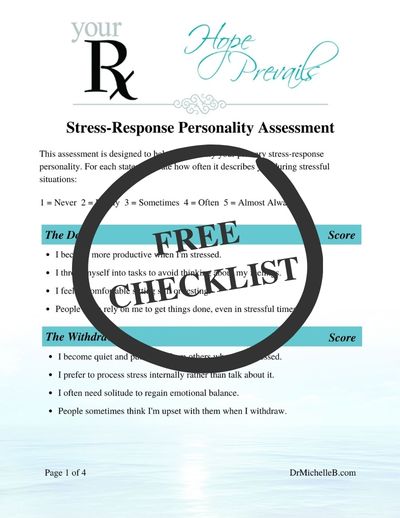
Stress rarely affects everyone the same way. Your brain, body, and emotions often respond in unique patterns shaped by your personality, past experiences, and nervous system.
This assessment will help you identify your primary stress-response personality so you can better understand how you react under pressure, recognize your stress patterns, and begin moving toward healthier, faith-filled responses.
Get the assessment here: Stress-Response Personality Assessment
About Holly Andrews:
 Holly Andrews was born and raised in Orlando, Florida. She holds a degree in Interdisciplinary Studies from Covenant College and a Master’s in Russian from Middlebury College. Her early career took her overseas to Russia, where she lived for three years before joining the National Security Agency in 2005. Over the next 17 years, Holly rose to an executive leadership role, overseeing cutting-edge technology operations, leading high-profile teams and projects until her departure in 2022.
In 2019, a personal health crisis became the unexpected turning point that changed everything. As Holly began to heal physically, she rediscovered a deeper sense of purpose that led her to pursue health coaching. She is now a certified Integrative Nutrition Health Coach and the founder of Andrews Coaching & Transformation, where she helps others reduce stress, restore balance, and reclaim their well-being.
Holly is the author of Heal Your Stress from the Inside Out, a guide to addressing stress through a holistic, root-cause approach. She is passionate about empowering others to transform their health from the inside out.
Connect with Holly: Website / Facebook / Instagram / LinkedIn


