

Fear doesn’t always look like panic. Sometimes it looks like procrastination, perfectionism, overthinking, people-pleasing, indecision, or staying quiet when you know you need to speak. Sometimes fear looks remarkably responsible. You may tell yourself you’re being cautious, waiting for the right time, gathering more information, or trying to make sure you don’t make the wrong decision. And sometimes those things are true. But sometimes what looks like wisdom is actually fear quietly asking you to stay where you are.
That distinction matters because fear doesn’t only affect how we feel. Fear can influence what we do, what we avoid, what we postpone, and ultimately what we miss. When fear becomes the force directing our decisions, we may gradually find ourselves living within boundaries we never consciously chose.
Why Does Fear Make Us Avoid Things That Matter?
Your brain is designed to protect you from perceived danger, and avoidance is one of the ways it does that. When something feels threatening, your brain naturally looks for a way to reduce that threat. Sometimes the most immediate way to do that is to move away from whatever feels uncomfortable.
If you’re afraid of rejection, you may avoid putting yourself out there.
If you’re afraid of failure, you may procrastinate.
If you’re afraid of conflict, you may keep quiet.
If you’re afraid of disappointing someone, you may say yes when you desperately want to say no.
And if you’re afraid that you aren’t good enough, you may keep preparing long after you’re actually ready.
The interesting thing about avoidance is that it often works in the short term.
You don’t send the email, so you don’t have to risk rejection.
You don’t have the conversation, so you don’t have to experience conflict.
You don’t submit the manuscript, so you don’t have to discover whether someone liked it.
You don’t apply for the opportunity, so you don’t have to find out whether you were qualified.
For a moment, your anxiety decreases. Your body relaxes. Your mind gets some relief.
Your brain can learn from that experience.
It can begin to associate avoidance with safety because avoiding the situation made the uncomfortable feeling go away. The next time something similar happens, avoiding it may feel even more compelling. Over time, what started as an attempt to protect yourself can become a pattern that keeps you from moving toward the things that matter most.
Avoidance Can Feel Like Relief, But Relief Isn’t Always Peace
This is an important distinction when you’re trying to understand your own behavior. When you avoid something that frightens you, you may experience immediate relief. Your heart rate settles. Your thoughts slow down. The tension decreases. It feels better.
But feeling better in the moment doesn’t necessarily mean you’ve resolved the underlying fear. Sometimes you’ve simply taught your brain that the safest way to handle discomfort is to escape it.
That can make the feared situation feel even more threatening the next time you encounter it because you haven’t had the opportunity to discover that you can tolerate the discomfort, respond effectively, and come through it. The more we avoid, the fewer opportunities we have to learn that we can cope.
This is why fear can become self-reinforcing. Avoidance reduces discomfort today, but it can increase the power of fear tomorrow.
What Does Fear-Based Avoidance Look Like in Everyday Life?
Most of us recognize obvious fear. We know what it feels like to have a racing heart, sweaty palms, a tight chest, or an overwhelming urge to get away. But fear can be much quieter than that.
It can sound like, “I’ll do it when I’m more confident,” or “I’ll start when things calm down.”
It can sound like, “I need to research this a little more first,” or “Maybe someone else would be better at this.”
It can sound like, “I don’t want to disappoint anyone,” “What if I make the wrong choice?” or even, “It’s probably not that important anyway.”
Sometimes those thoughts reflect genuine wisdom or discernment. The problem is that fear and wisdom can sometimes sound remarkably similar.
That’s why it can be helpful to ask yourself not only, “What am I thinking?” but also, “What am I avoiding?”
The answer may reveal something important. You may discover that you aren’t actually avoiding the task itself. You’re avoiding what you fear the task might make you feel.
You may not be afraid of sending the email as much as you’re afraid of being rejected.
You may not be afraid of having the conversation as much as you’re afraid of someone’s response.
You may not be afraid of trying as much as you’re afraid of discovering that you aren’t as capable as you hoped.
Once you identify the fear underneath the avoidance, you have something much more useful to work with.
Fear and Perfectionism Often Travel Together
Perfectionism is another way fear can disguise itself.
If you believe you need to get everything exactly right, you can delay beginning indefinitely.
If you never feel ready enough, you can avoid the possibility of making a mistake.
Perfectionism can create an illusion of control.
If I prepare enough, perhaps nothing will go wrong.
If I anticipate every possible problem, perhaps I won’t be embarrassed.
If I make this flawless, perhaps no one can criticize me.
But perfection is an impossible standard and pursuing it can leave you exhausted while keeping you from actually doing the things that matter.
Fear doesn’t have to convince you to quit. Sometimes it only has to convince you to keep waiting.
That can be particularly costly when the thing you’re waiting to do is connected to something meaningful. A book you want to write, a conversation you need to have, an opportunity you want to pursue, a boundary you need to establish, or a dream you’ve carried for years can remain permanently on the other side of “someday.”
What Happens When Fear Turns Into Overthinking?
Fear also has a way of turning the mind into a problem-solving machine that never reaches a solution. You replay conversations, anticipate every possible outcome, imagine what could go wrong, ask other people what they think, and then reconsider the advice you’ve received.
At some point, what began as thoughtful consideration becomes mental exhaustion.
I’ve written before about the relationship between overthinking and trusting God because overthinking can create the illusion that if we just think long enough, we can eliminate uncertainty. But we can’t. There will always be things we don’t know, and there will always be outcomes we cannot control.
Sometimes continuing to analyze isn’t helping us make a better decision. It’s helping us postpone making one.
That doesn’t mean you should stop thinking carefully. Thoughtfulness is valuable. Discernment is valuable. But there is a difference between carefully considering a decision and repeatedly revisiting the same possibilities because you’re hoping to find a level of certainty that life cannot provide.
Fear Can Keep You from Becoming Who You Are Becoming
This is where fear becomes more than an emotional experience. It can begin shaping your identity.
If you repeatedly avoid difficult things because you’re afraid you can’t handle them, you may eventually start believing that you’re incapable.
If you continually stay silent because you’re afraid of how others will respond, you may begin believing that your voice doesn’t matter.
If you keep turning down opportunities because you’re afraid of failing, you may eventually convince yourself that you’re not someone who takes risks.
If you continually choose what is comfortable over what is meaningful, you may start defining yourself by the limits fear has created.
But avoidance isn’t proof that you are incapable. It may simply mean you’ve become very practiced at protecting yourself.
And what has been learned can be changed.
Your brain is capable of learning new patterns. Each time you take a manageable step toward something you’ve been avoiding, you give your brain an opportunity to learn something different. You may discover, “I can do hard things. I can tolerate uncertainty. I can survive disappointment. I can have a difficult conversation. I can make a mistake and recover. I can feel afraid and still move forward.”
Those experiences matter because they provide your brain with new information. Instead of continually learning that discomfort must be escaped, your brain begins learning that discomfort can sometimes be tolerated and navigated.

What Does Faith Have to Do with Moving Forward When You’re Afraid?
For those of us who follow Christ, there is another question worth asking: What if faith isn’t the absence of fear but the willingness to move forward while fear is still present?
We sometimes assume that if God is leading us somewhere, we’ll automatically feel confident about going there. But Scripture doesn’t promise that obedience will always feel comfortable.
Moses felt inadequate.
Gideon felt afraid.
Joshua needed repeated reminders to be strong and courageous.
Peter stepped out of the boat while the storm was still raging.
Courage, by definition, doesn’t require the absence of fear. Courage means responding to what matters even when fear is present.
That doesn’t mean every uncomfortable opportunity is God’s assignment for you. Discernment matters. Wisdom matters. Healthy boundaries matter. Sometimes walking away is exactly the right choice. But fear alone shouldn’t be the deciding factor.
A useful question may be, “If I knew I could not fail, what would I be willing to do?” Then ask a second question: “What is one small step toward that thing that I could take even if I still feel afraid?”
You don’t have to leap. You may only need to take the next faithful step.
How Can You Tell Whether You’re Being Wise or Avoiding Something Because You’re Afraid?
This can be difficult because fear and wisdom can sometimes sound remarkably similar. Both can tell you to pause. Both can encourage caution. Both can make you reconsider a decision.
One way to sort through the difference is to examine what is underneath your hesitation. Ask yourself, “Am I avoiding this because it is genuinely unsafe, or because it is uncomfortable?” Then consider whether you would make the same decision if fear were removed from the equation.
You might also ask, “Am I gathering information, or am I using information-gathering to postpone action?” “Am I honoring a healthy boundary, or am I avoiding something simply because I don’t want to feel uncomfortable?” And perhaps most importantly, “What is the smallest step I could take without abandoning wisdom or safety?”
These questions don’t require you to ignore your fear. They help you listen to it without automatically obeying it.

You Don’t Have to Eliminate Fear Before You Move
One of the biggest misconceptions about courage is that you have to feel brave before you act. Often, courage works in the opposite direction.
You take the step, and then you discover that you can take the step. Your brain receives new information. The next step becomes a little more possible.
That’s how confidence often develops. Not because you waited until you felt completely confident, but because you accumulated experiences that showed you that you could handle what you were afraid to face.
Sometimes the first step is very small.
You make the phone call.
You set the boundary.
You submit the application.
You open the document.
You have the conversation.
You ask for help.
You tell the truth.
You try again.
You don’t have to conquer your entire fear today. You simply have to decide whether fear gets to make today’s decision for you.
What If You’re Afraid Because You’ve Been Hurt Before?
This is where compassion matters.
Not all avoidance is irrational. If you’ve experienced betrayal, trauma, rejection, abuse, failure, or significant loss, your hesitation may have a history. Your brain learned something from what happened.
That doesn’t mean every warning signal is accurate now, but it does mean your response deserves compassion rather than criticism.
If fear has become deeply rooted because of past experiences, professional support can help you process what happened while learning healthier ways to respond in the present. The goal isn’t to become someone who never notices danger. The goal is to become someone who can distinguish real danger from remembered danger, wise caution from fear-based avoidance, and healthy boundaries from walls built by fear.
If you’ve experienced trauma or prolonged stress, it may also help to understand how those experiences can influence the brain and nervous system. My article on rewiring the brain after trauma and stress explores why the brain can become more vigilant after difficult experiences and why change remains possible.
You don’t have to shame yourself into courage. Sometimes the bravest thing you can do is acknowledge why something feels frightening and then seek the support you need to take a healthy next step.
What Matters Enough for You to Move Toward It?
Perhaps the most important question isn’t, “How do I get rid of my fear?”
Perhaps it’s, “What matters enough to me that I’m willing to feel some fear while pursuing it?”
Your answer may have something to do with your marriage.
It may be a relationship that needs an honest conversation.
It may be a dream you’ve postponed.
It may be a calling you keep dismissing because you don’t feel qualified.
It may be the boundary you’ve been afraid to establish.
It may be asking for help or beginning again after disappointment.
It may simply be allowing yourself to become more fully who God created you to be.
Fear will always have something to say. The question is whether fear gets the final word.
You can listen to fear without obeying it.
You can acknowledge the possibility of failure without assuming failure is inevitable.
You can recognize uncertainty without allowing uncertainty to paralyze you.
And you can take a faithful step even when your hands are shaking.
Maybe Courage Looks Different Than You Thought
I’ve had plenty of moments when I would have preferred to feel completely certain before taking the next step. Maybe you know that feeling too.
We want reassurance that everything will work out. We want to know that we won’t be disappointed, rejected, misunderstood, or hurt. We want to know that we’re making the right decision before we make it.
I understand that desire.
But life rarely gives us that kind of guarantee.
Sometimes all we have is enough light for the next step. Maybe that’s not a failure of faith. Maybe that’s where faith becomes real.
Not when we finally stop feeling afraid, but when we decide that fear doesn’t get to determine the direction of our lives.
So, if you’ve been putting something off because you’re afraid, I’m not going to tell you to simply “be brave.” Instead, I’d invite you to get curious.
What are you really afraid might happen?
What has your brain learned to associate with danger?
What are you avoiding?
And what matters enough that you might be willing to take one small step toward it?
You don’t have to figure everything out today.
You don’t have to become fearless.
You don’t even have to feel particularly courageous.
Maybe today, you simply take the next step.
And if you’re anything like me, you may discover that courage doesn’t always feel like confidence. Sometimes it feels like a shaky breath, a whispered prayer, and a quiet decision to move forward anyway.
If that’s where you are today, I hope you know that you don’t have to walk that road perfectly, and you don’t have to walk it alone. I’m cheering for you from here, and I’m taking my own next step too.
Because of Him, Hope Prevails.
Questions People Often Ask
How does fear cause avoidance?
Fear can activate the brain’s threat response, leading us to move away from situations that feel uncomfortable or threatening. Avoidance can produce immediate relief, which can unintentionally reinforce the behavior and make future avoidance more likely.
Why do I procrastinate when I’m afraid?
Procrastination can sometimes function as avoidance. Delaying a task temporarily removes the discomfort associated with uncertainty, possible failure, criticism, or other feared outcomes. The relief can reinforce the delay even though the underlying problem remains.
Is avoidance always bad?
No. Avoidance can be protective when something is genuinely dangerous or when a situation violates healthy boundaries. The important question is whether you’re avoiding something because it is unsafe or because it is uncomfortable.
How can I stop letting fear control my decisions?
Begin by identifying what you are actually afraid might happen. Then distinguish genuine danger from discomfort and ask what small, wise step you could take toward what matters. You don’t have to eliminate fear before moving forward.
Does faith mean I shouldn’t be afraid?
No. Faith does not require the absence of fear. Throughout Scripture, people experienced fear while still choosing trust, obedience, and courage. Faith can give you a foundation from which to respond to fear rather than allowing fear to make every decision for you.
Additional Resources for Overcoming Fear and Anxiety
(If there are affiliate links in this post, meaning, if you click through and make a purchase, I may receive a commission (at no extra cost to you)).
If fear and anxiety have been keeping you from experiencing God’s peace, I want to share a few additional resources to encourage you. Whether you’re looking for biblical truth, practical strategies, or a deeper understanding of how fear affects your brain, these resources can help you take your next step toward greater peace and freedom.
- How Fear Rewires Your Brain and How Faith Helps You Break Free: Listen to this episode of Your Hope-Filled Perspective to learn how fear affects the brain and how faith can help you break free from unhealthy patterns.
- Breaking Anxiety’s Grip: Find biblical encouragement and practical strategies in my book to help you loosen fear’s hold and reclaim God’s promises.
- Breaking Anxiety’s Grip Free Study Guide: Use this companion guide to reflect on what you’re learning and put biblical truth into practice.
- 7-Day YouVersion Bible Reading Plan: Spend seven days focusing on God’s promises as you learn to respond to fear with faith.
- Free Printable: How to Fight Fearful and Anxious Thoughts and Win: Keep practical reminders close by to help you respond when fearful thoughts arise.
- 40 Scriptures to Combat Worry, Fear, and Anxiety: Turn to these Bible verses when you need reassurance, encouragement, and reminders of God’s faithfulness.
Cheering You On,
Dr. Michelle
Fear doesn't always look like panic. Sometimes it looks like procrastination, perfectionism, or overthinking. Learn how fear can quietly keep you from what matters most and how faith helps you move forward. Share on X Fear doesn't have to convince you to quit. Sometimes it only has to convince you to keep waiting. You don't have to feel fearless to take the next step. Faith can help you move forward even when you're afraid. Share on X
Get your Free Stress-Response Personality Assessment
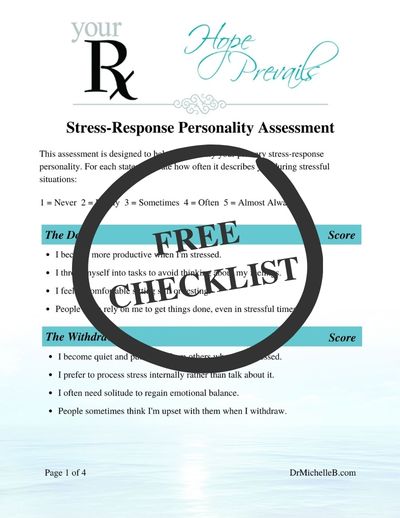
Stress rarely affects everyone the same way. Your brain, body, and emotions often respond in unique patterns shaped by your personality, past experiences, and nervous system.
This assessment will help you identify your primary stress-response personality so you can better understand how you react under pressure, recognize your stress patterns, and begin moving toward healthier, faith-filled responses.
Get the assessment here: Stress-Response Personality Assessment


