

You thought it would turn out differently.
Maybe you expected the job offer. You thought the relationship would last. You prayed for a different outcome. You believed this time would be different. Perhaps you worked hard, did everything you knew to do, and still ended up facing a result you never anticipated.
Disappointment can hurt far more than the circumstances seem to justify. Sometimes the event itself is relatively small, yet the emotional response feels surprisingly large.
Why does disappointment hurt so much?
Part of the answer is found in the way the brain processes expectations, rewards, and unexpected outcomes. Disappointment is not simply a matter of having a bad attitude or failing to trust God. It is a complex emotional experience involving prediction, learning, meaning, and hope.
Understanding what happens in your brain when disappointment occurs can help you respond to it with greater compassion and clarity.
What is disappointment, psychologically?
Disappointment occurs when the outcome we experience falls short of what we expected, wanted, or believed would happen.
That gap between what we anticipated and what actually happened is important.
Your brain is constantly making predictions. Based on past experiences, current circumstances, and the meaning you assign to something, your brain develops expectations about what is likely to happen next. When reality doesn’t match the prediction, the brain registers an error that can prompt learning and adjustment. Researchers often refer to this as a prediction error.
That doesn’t mean your brain has made a mistake in the ordinary sense. Prediction errors are part of how the brain learns.
But when the difference between expectation and reality involves something deeply meaningful, the emotional impact can be substantial.
The disappointment isn’t simply, “I didn’t get what I wanted.”
It can become, “I thought this was going to work.”
Or, “I thought I could trust them.”
Or even, “I thought God was going to answer this prayer differently.”
Now the disappointment carries meaning.
Why does disappointment hurt so much?
Your brain was preparing for a different outcome
When you anticipate something positive, your brain doesn’t wait passively for the outcome. It begins preparing for it.
Research on reward processing has demonstrated that dopamine neurons are involved in signaling the difference between expected and actual reward. When an outcome is better than expected, the signal differs from when the outcome is exactly what was anticipated or worse than expected. These prediction-error signals play an important role in learning and adapting future behavior.
This helps explain why disappointment can feel like more than sadness.
Your brain wasn’t simply responding to what happened. It was also responding to the loss of what it expected to happen.
You had already begun mentally moving toward that future.
Then suddenly, you had to move backward.
The more meaningful the expectation, the greater the potential pain
Not every unmet expectation produces the same emotional response.
If you expected your favorite restaurant to have your usual dessert and they were sold out, you might be mildly disappointed.
If you expected a person you love to keep a promise and they didn’t, the disappointment may cut much deeper.
That’s because disappointment is influenced not only by the outcome but by what the outcome represented.
A failed opportunity might represent security.
A relationship ending might represent belonging.
A prayer that appears unanswered might challenge your understanding of what you thought God was doing.
A professional setback might touch your sense of competence or worth.
The brain doesn’t process these experiences in isolation. Your thoughts, memories, expectations,
relationships, and sense of identity all contribute to the emotional experience.
Why can one disappointment bring back many others?
Sometimes today’s disappointment seems to contain yesterday’s disappointments too.
A current setback can activate memories of earlier experiences that carried a similar emotional meaning. The result can be a response that feels disproportionate to the immediate circumstance.
You aren’t necessarily overreacting.
Your brain may be responding to the present experience while also drawing on what it has learned from the past.
This is especially important when disappointment occurs repeatedly. Over time, repeated negative outcomes can influence expectations about what will happen next. Research on reward processing suggests that learning from outcomes is a complex process involving multiple brain systems, and disturbances in reward learning and valuation are also associated with depression and anhedonia.
That doesn’t mean disappointment causes depression. It does mean that repeated experiences of disappointment can affect motivation, expectations, and the way we approach future opportunities.
After enough disappointments, you may begin protecting yourself by expecting less.
Sometimes what looks like pessimism is actually a brain attempting to prevent another painful surprise.
Why does disappointment sometimes affect your identity?
One of the most painful forms of disappointment happens when the outcome feels like a verdict about you.
I didn’t get the promotion becomes, “I’m not good enough.”
The relationship ended becomes, “I’m not lovable.”
My child is struggling becomes, “I’ve failed as a parent.”
This opportunity didn’t work out becomes, “I’ll never succeed.”
The event and the interpretation are not the same thing.
Disappointment tells you that something didn’t happen the way you hoped. Shame often takes the next step and tells you that you are the problem.
That distinction matters.
You can acknowledge, “This hurts because I deeply wanted this,” without concluding, “This proves something terrible about me.”
Sometimes the most important work after disappointment is separating what happened from what you are tempted to believe it means about you.
What does faith have to do with disappointment?
For people of faith, disappointment can carry another layer of complexity.
Sometimes we aren’t only disappointed by circumstances. We’re disappointed because we thought we understood what God was going to do.
We prayed.
We hoped.
We believed.
And then the answer looked nothing like what we expected.
Scripture doesn’t require us to pretend that doesn’t hurt. In fact, Proverbs 13:12 gives language to the experience: “Hope deferred makes the heart sick.”
The Bible makes room for the ache of deferred hope.
Faith doesn’t mean never feeling disappointed. Faith means we don’t have to make disappointment the final authority over what is true.
There is a difference between saying, “This isn’t what I hoped would happen,” and saying, “Because this didn’t happen, there is no hope.”
The first is honest.
The second may be a conclusion made from pain.
Hope can coexist with disappointment because the neuroscience of hope reminds us that hope is not simply wishful thinking, while biblical hope is ultimately rooted not in our ability to predict an outcome, but in the character of God.

How can you move through disappointment without getting stuck?
The first step isn’t forcing yourself to feel better.
It is allowing yourself to acknowledge what you actually lost.
Sometimes disappointment involves a tangible loss. Other times, you are grieving an anticipated future that never materialized. That loss is still emotionally meaningful.
Give yourself permission to name it.
Then become curious about the expectation underneath the disappointment.
Ask yourself:
- What did I hope would happen?
- What did that outcome represent to me?
- What am I telling myself this disappointment means?
- Is that conclusion actually true?
- What remains true even though this didn’t turn out as I hoped?
That last question can be particularly important.
Disappointment changes circumstances. It doesn’t necessarily change your identity, your worth, God’s character, or the possibility of a meaningful future.
You may also need to allow your expectations to recalibrate. The brain learns from experience, but one disappointing outcome doesn’t have to become a permanent prediction about every future outcome.
There is a difference between wisdom and hopelessness.
Wisdom says, “I learned something from what happened.”
Hopelessness says, “Nothing good will ever happen again.”
Disappointment doesn’t mean you hoped too much
Sometimes we criticize ourselves for caring so deeply.
Maybe we think we wouldn’t hurt so much if we had simply expected less.
But disappointment can reveal that something mattered.
You hoped because you cared.
You anticipated because you had invested.
You grieved because the outcome carried meaning.
The goal isn’t to become someone who never hopes in order to avoid disappointment. The goal is to become someone who can experience disappointment without allowing it to define the future.
That takes emotional honesty, thoughtful reflection, and sometimes the courage to hope again.
And if disappointment has become so persistent that you are experiencing ongoing hopelessness, loss of interest or pleasure, significant changes in functioning, or difficulty moving forward, it may be more than a temporary emotional response. Reward processing and motivation can be affected in depression, and persistent symptoms deserve appropriate professional attention.
Your disappointment deserves to be understood, not dismissed.
And perhaps understanding why it hurts is part of how you begin to heal.

What People Are Asking About Why Disappointment Hurts So Much
Why does disappointment feel like grief?
Because disappointment can involve the loss of an anticipated future. You may be grieving not only what happened, but what you thought would happen. The emotional response can be particularly strong when the expectation involved a meaningful relationship, dream, opportunity, or hope.
Why do I keep thinking about what happened?
Your brain naturally tries to make sense of unexpected outcomes. Replaying the situation can be part of learning and meaning-making. But repeated rumination can keep you emotionally stuck. Reflecting on what you can learn is different from repeatedly rehearsing what you wish had happened.
Can disappointment cause depression?
A single disappointment does not automatically cause depression. However, repeated losses, chronic stress, and ongoing experiences of failure or rejection can contribute to emotional vulnerability. Depression also involves broader symptoms such as persistent low mood, loss of interest or pleasure, and changes in functioning.
Why does disappointment make me afraid to hope again?
When something painful happens, your brain learns from the experience. One way it may attempt to protect you is by lowering expectations so you won’t be surprised again. That protection can become limiting when it prevents you from engaging with future possibilities.
How can I trust God after a disappointing outcome?
You can be honest about your disappointment without abandoning your faith. Trust does not require pretending you understand why something happened. Sometimes faith looks less like having an explanation and more like continuing to believe that God is present and trustworthy when the outcome is still unresolved.
Disappointment hurts because something mattered.
You hoped because you cared. You anticipated because you had invested. You grieved because you had imagined a future that mattered to you. There is no shame in that.
The answer isn’t to become someone who never hopes again just because hope can sometimes hurt. Nor is it to convince yourself that the disappointment shouldn’t matter. Healing begins when you can tell the truth about what you lost while refusing to let that loss define what comes next.
You may not be able to change the outcome. You may not understand why things unfolded the way they did. And you may need time to grieve the future you thought you were going to have.
But disappointment does not get the final word.
You can learn from what happened without becoming defined by it. You can acknowledge what hurts without assuming it will always hurt this much. And you can make room for hope again, even if that hope looks different than it did before.
Sometimes the first step forward isn’t finding an explanation. It’s simply being able to say, This wasn’t what I hoped for.
And then, when you’re ready, asking:
What might still be possible from here?
For a deeper look at the questions that can arise when God doesn’t respond the way we hoped, consider reading Disappointment with God: Three Questions No One Asks Aloud by Philip Yancey. Yancey addresses some of the difficult questions believers may hesitate to voice and offers a thoughtful perspective on trusting God when our expectations and circumstances don’t align.
Cheering You On,
Dr. Michelle
Why does disappointment hurt so much? Your brain was preparing for a different outcome. Understanding what happens when reality doesn’t match your hopes can help you begin to heal. Share on X Disappointment doesn’t mean you hoped too much. It means something mattered. Learn why disappointment can hurt so deeply and how to move forward without giving up hope. Share on X
Get your Free Stress-Response Personality Assessment
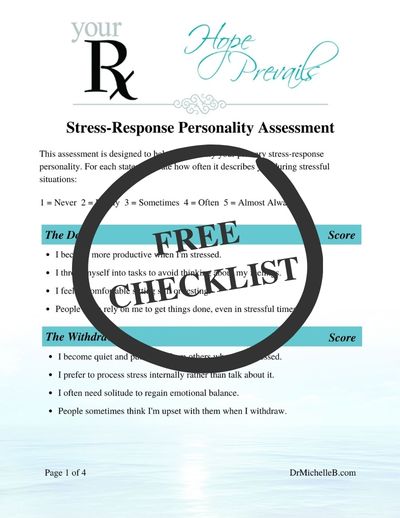
Stress rarely affects everyone the same way. Your brain, body, and emotions often respond in unique patterns shaped by your personality, past experiences, and nervous system.
This assessment will help you identify your primary stress-response personality so you can better understand how you react under pressure, recognize your stress patterns, and begin moving toward healthier, faith-filled responses.
Get the assessment here: Stress-Response Personality Assessment


