

Have you ever noticed how much harder it can be to relax when you don’t know what is going to happen?
Maybe you are waiting for medical test results, wondering whether your adult child is going to make a wise decision, anticipating an important conversation, waiting to hear about a job opportunity, or simply trying to navigate a season of life that feels unfamiliar. Nothing may actually be wrong in this moment, yet your body feels as though something is.
You may find yourself checking your phone repeatedly, replaying conversations, imagining worst-case scenarios, researching possibilities, or mentally rehearsing what you will say if something goes wrong. You may even tell yourself, “I just want to know what’s going to happen.”
That desire makes sense. Your brain is wired to seek predictability.
Uncertainty is difficult because the brain’s primary responsibility is not to make you comfortable. It is to keep you alive. When the brain cannot determine what is coming next, it has to decide whether the unknown represents a potential threat. And when the answer is unclear, your brain may err on the side of caution.
That is why uncertainty can keep your nervous system on high alert even when you are technically safe.
Why Does Uncertainty Make Anxiety Worse?
Your brain is constantly predicting what will happen next. It draws on previous experiences, current information, and patterns it has learned over time to anticipate what might be coming. Most of the time, this predictive ability serves you well. It allows you to plan, make decisions, recognize danger, and move through daily life without consciously analyzing every possibility.
But uncertainty disrupts that predictive process.
When your brain cannot confidently anticipate an outcome, it may increase vigilance. You become more attentive to potential threats because your brain is essentially asking, “What am I missing?”
This is one reason uncertainty can be more distressing than a difficult reality that is already known. When you know what you are dealing with, your brain can begin developing a response. When you do not know, your brain may continue scanning.
You might not even realize you are doing it.
You may call it overthinking. You may call it worrying. You may say you are trying to prepare yourself. But underneath all of those behaviors may be a brain attempting to reduce uncertainty so it can finally stand down.
This helps explain why you can feel exhausted from thinking about something that has not even happened.
The event itself may require very little energy. The anticipation of every possible version of the event can consume enormous amounts of it.
Your Brain Would Rather Have a Difficult Answer Than No Answer
There is an important distinction between danger and uncertainty.
Sometimes we know something is difficult, painful, or disappointing, but we also know what we are facing. Other times, we are caught in the space between what was and what will be. That space can be particularly uncomfortable because there is no clear action to take.
The brain does not particularly like open loops.
When something feels unresolved, your mind may repeatedly return to it in an attempt to complete the picture. You may revisit the conversation, search for additional information, ask other people what they think, or imagine different outcomes. The hope is that if you think about it long enough, you will finally arrive at certainty.
But sometimes certainty is not available.
And that is where anxiety can become self-perpetuating.
The more you try to eliminate every possibility of uncertainty, the more your brain learns that uncertainty itself must be dangerous. Instead of learning, “I can tolerate not knowing,” the brain may learn, “I must keep thinking until I know.”
That is an exhausting way to live.
It can also quietly shrink your life because you begin postponing decisions, avoiding situations with unpredictable outcomes, or waiting for a sense of certainty that may never come.
What Happens in the Brain When You Feel Uncertain?
When your brain perceives a possible threat, the amygdala helps activate the body’s stress response. Your heart rate may increase. Your muscles may tense. Stress hormones such as cortisol and adrenaline help prepare you to respond.
This response is protective when danger is immediate.
The difficulty comes when the perceived threat is hypothetical, distant, or ambiguous, yet your nervous system responds as though you need to prepare for something right now.
Under sustained stress, higher-order thinking can become more difficult. The prefrontal cortex, which plays an important role in reasoning, planning, decision-making, and regulating emotional responses, does not function optimally when the brain is persistently overwhelmed by threat signals.
That is one reason anxiety can make you feel unlike yourself.
You may know logically that your fear is disproportionate, yet your body does not seem convinced. You may tell yourself, “There is no reason to panic,” while your stomach remains tight and your mind continues racing.
Your body is not necessarily responding to what you know intellectually. It is responding to what your brain perceives as possible.
And possible can feel very real.
Uncertainty Can Turn Your Imagination Against You
One of the most challenging things about uncertainty is that the brain can fill in missing information.
Unfortunately, it does not always fill in the blanks with the most reassuring explanation.
If you do not know what someone is thinking, your mind may assume they are upset with you. If you do not know what a medical test will reveal, you may imagine the worst diagnosis. If you do not know what your adult child is doing, you may mentally rehearse everything that could go wrong.
The brain is attempting to prepare you.
But preparation can become rumination when there is no new information and no meaningful action available.
This is why I have written before about how worry projects our thoughts into an unknown future. Worry can create the illusion that we are doing something productive when, in reality, we may simply be rehearsing possibilities over which we have no control.
There is a difference between preparing for what you can reasonably anticipate and repeatedly trying to solve a future that has not happened.
The first can be wisdom.
The second can keep your nervous system activated.
Why Does Waiting Feel So Much Harder Than Knowing?
Waiting is difficult because it removes one of the things our brains crave: agency.
When there is something you can do, action can help restore a sense of control. You can make a phone call. Gather information. Make a plan. Set a boundary. Ask a question. Take the next step.
But sometimes there is no next step yet.
Sometimes you have done everything you can do, and now you have to wait.
That can feel almost intolerable when your brain has learned to equate action with safety.
This is particularly important for people who have experienced significant stress or trauma. Previous experiences can teach the nervous system to remain vigilant because unexpected events have occurred before. As I’ve discussed in rewiring the brain after trauma and stress, the brain is remarkably adaptive. It learns from what we repeatedly experience, including experiences that leave us feeling unsafe.
That does not mean every person who struggles with uncertainty has experienced trauma. It simply means our history can influence how readily our brains interpret ambiguity as a potential threat.
Sometimes the present uncertainty is difficult because of what is happening now.
Sometimes it is also touching something the brain remembers from before.

You Don’t Have to Know the Outcome to Be Okay Today
This is where faith offers something profoundly different from the promise of certainty.
Scripture does not promise that we will always know what is coming next. Instead, it repeatedly invites us to trust the One who does.
That is a very different kind of security.
Proverbs 3:5-6 reminds us to trust in the Lord rather than leaning entirely on our own understanding. Isaiah 41:10 reminds us that God is with us and will strengthen and help us. Philippians 4:6-7 invites us to bring our concerns to God in prayer and promises a peace that guards our hearts and minds.
Notice what these passages do not say.
They do not say, “You will understand everything.”
They do not say, “You will know exactly how this will turn out.”
They point us toward something deeper: God’s presence in the middle of what we cannot predict.
That matters neurologically as well as spiritually.
When we repeatedly remind ourselves of what is true, redirect our attention, slow our breathing, pray, and engage our bodies in ways that communicate safety, we can begin interrupting the cycle of escalating threat. We are not pretending the uncertainty does not exist. We are helping our brains learn that uncertainty does not automatically mean danger.

What Can You Do When Uncertainty Keeps Your Brain on High Alert?
Start by recognizing what is happening without criticizing yourself for it.
Instead of saying, “Why can’t I just stop worrying?” try noticing, “My brain is searching for certainty because it doesn’t know what comes next.”
That small shift matters. It moves you from fighting yourself to understanding yourself.
Then ask a more useful question: What is actually mine to do right now?
If there is an action available, take it. If there isn’t, acknowledge that too. You may need to remind yourself, “There is nothing I need to solve in this moment.”
You can also distinguish between facts and predictions. What do you actually know? What are you imagining? What information are you missing? What would you tell a friend who was making the same assumptions?
These questions can help bring your attention out of the imagined future and back into the present.
And then there is the spiritual practice of surrender.
Surrender does not mean you stop caring. It does not mean you become passive or refuse to plan. It means you acknowledge the limits of your control and entrust what you cannot control to God.
I have written previously about focusing on God rather than allowing the facts to become the whole story. The facts matter. But the facts are not the only truth available to you.
You may not know what tomorrow holds, but you can know who holds tomorrow.
That distinction can become an anchor when your brain is desperate for certainty.
Peace Does Not Require Knowing What Happens Next
We often assume that peace will come once the uncertainty is resolved.
But sometimes the greater work is learning that peace can exist before the answer arrives.
That does not happen overnight. A chronically activated nervous system may need repeated experiences of safety before it stops scanning so intensely. The brain learns through repetition. When we repeatedly practice slowing down, grounding ourselves in the present, challenging catastrophic predictions, seeking wise support, praying, and remembering God’s character, we give the brain new experiences from which to learn.
This is one reason I often return to the biblical invitation to “be still and know.” Stillness is not simply sitting quietly. It can be a profound interruption of the frantic attempt to control what cannot yet be known. In The Neuroscience Behind God’s Command to “Be Still and Know”, I explore how stillness can help create the conditions in which the brain can move out of heightened threat and reconnect with truth, reflection, and trust.
You may not be able to eliminate uncertainty from your life.
None of us can.
There will always be unanswered questions, waiting rooms, changing relationships, unexpected diagnoses, financial decisions, transitions, and circumstances that refuse to give us guarantees.
But you can learn to respond differently to the unknown.
You can notice when your brain begins scanning for danger. You can separate what is happening from what you fear might happen. You can take the next faithful step rather than demanding a map for the entire journey. You can care for your nervous system instead of shaming it for reacting. And you can remind yourself that the absence of certainty does not mean the absence of God.
Sometimes faith looks less like knowing what will happen and more like trusting God when you don’t.
Your brain may keep asking, “What if?”
Faith can answer, “Even then, God will be with me.”
And sometimes that is enough to help your body finally take a breath.
Hope Prevails!
Dr. Michelle
Does waiting for answers leave your mind racing with worst-case scenarios? Find out why uncertainty triggers your brain's stress response and what you can do to calm it. Share on X You don't have to know what happens next to experience peace. See how neuroscience and faith can help you stop overthinking, manage uncertainty, and trust God in the waiting. Share on X
Get your Free Stress-Response Personality Assessment
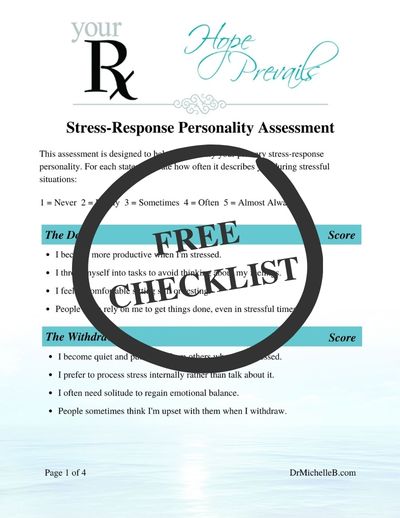
Stress rarely affects everyone the same way. Your brain, body, and emotions often respond in unique patterns shaped by your personality, past experiences, and nervous system.
This assessment will help you identify your primary stress-response personality so you can better understand how you react under pressure, recognize your stress patterns, and begin moving toward healthier, faith-filled responses.
Get the assessment here: Stress-Response Personality Assessment


Thank you Dr Michelle for this profound email. I appreciate it.
Zenzo,
I’m so glad this article blessed you!
Hope Prevails,
Dr. Michelle
Thank you so much for this article. Just what i needed to read
Tracy,
Thank you for taking the time to let me know. That blesses my heart!
With Hope,
Dr. Michelle
This is so timely for me and it has really blessed me, especially as I navigate several transitions and getting ready to coach for change and transitions.
Truly, “preparation can become rumination when there is no new information and no meaningful action available.”
Preparation can easily sound like wisdom when awareness is not integrated into meaningful action.
God bless you Dr Michelle
Whitney,
Thank you for taking the time to comment.
I’m so glad to hear that this post blessed you. It’s easy to confuse rumination, preparation, and wisdom, but not all are equally fruitful!
Hope Prevails,
Dr. Michelle