

Have you ever walked into a room and immediately noticed that someone was upset? Maybe you could tell your spouse was frustrated before they said a word. Perhaps you sensed tension between family members and immediately started thinking about how to make things better. Maybe a friend was disappointed with you, and you spent the rest of the day wondering what you could do to make sure she wasn’t angry anymore.
You may tell yourself that you’re simply sensitive to other people’s feelings.
You care deeply.
You want peace in your relationships.
You don’t like seeing people hurt.
But sometimes something deeper is happening.
You aren’t just noticing other people’s emotions.
You are beginning to feel responsible for them.
And that’s a very heavy way to live.
When someone is disappointed, you feel guilty. When someone is angry, you assume you did something wrong. When someone is anxious, you feel compelled to fix the situation. When someone is unhappy, you find yourself searching for what you could do differently. You may even find yourself adjusting your words, changing your plans, suppressing your own preferences, or taking on responsibilities that were never actually yours simply to keep everyone else comfortable.
Eventually, you can become so accustomed to monitoring everyone else’s emotional temperature that you lose touch with your own.
Why Do I Feel Responsible for Other People’s Feelings?
For some people, this pattern develops gradually. Perhaps you learned early in life that keeping other people happy helped keep the environment around you peaceful. Maybe you grew up around unpredictable emotions, conflict, criticism, or instability, and you became exceptionally good at noticing subtle changes in other people’s moods.
You learned to watch faces, listen to tone of voice, anticipate reactions, and adjust accordingly.
That ability may have served an important purpose at the time. Your brain is remarkably adaptable, and repeated experiences can teach it what to pay attention to. When anticipating another person’s reaction helped you feel safer or maintain connection, your brain learned that monitoring other people was important.
Years later, however, the same strategy can continue operating long after the original circumstances have changed.
You may no longer be in an environment where you need to monitor everyone else’s mood for safety, but your nervous system may still respond as though someone else’s displeasure requires immediate action.
That can make ordinary relational discomfort feel like an emergency.
Someone is disappointed, and your brain says, I need to fix it.
Someone disagrees with you, and your brain says, You’ve done something wrong.
Someone is angry, and your brain says, Make them calm down.
Someone withdraws, and your brain says, What did I do?
The problem is that other people’s emotions aren’t yours to manage.
Caring About Someone Is Different from Managing Their Emotions
There is nothing wrong with caring about how another person feels. In fact, empathy is part of healthy relationships. We are called to love one another, bear one another’s burdens, encourage one another, and mourn with those who mourn.
But caring and controlling are not the same thing.
You can care that your husband is disappointed without believing you must eliminate his disappointment.
You can care that your adult child is frustrated without taking responsibility for fixing the situation.
You can listen to a friend’s anxiety without believing you have to make her feel calm.
You can apologize when you’ve genuinely hurt someone without assuming responsibility for every negative emotion they experience.
You can be compassionate without becoming responsible.
That distinction can be difficult when you’ve spent years equating love with keeping other people happy.
People Pleasing Can Make Other People’s Happiness Feel Like Your Job
If you struggle with people pleasing, someone else’s disappointment may feel more threatening than it actually is.
You may say yes when you really want to say no because you don’t want someone to be upset.
You may avoid difficult conversations because you don’t want conflict.
You may agree with someone even when you see things differently.
You may apologize simply because someone is unhappy, even when you haven’t done anything wrong.
Over time, this can create resentment.
You keep giving, accommodating, adjusting, and suppressing your own needs, while quietly hoping that everyone else will respond by being pleased with you.
But people pleasing doesn’t actually create lasting peace. It often creates an exhausting cycle in which you become increasingly disconnected from what you need while becoming increasingly dependent on other people’s approval.
I’ve written more about this pattern in Biblical Help for Codependency, where I explore the connection between people pleasing, perfectionism, insecurity, difficulty setting boundaries, and unhealthy relationship patterns.
You can love people without making their approval the measure of whether you’re doing enough.
You May Have Learned to Be “The Strong One”
Sometimes the belief that we’re responsible for everyone else’s happiness is connected to another identity: being the strong one.
You’re the one who keeps things moving.
You’re the one who remembers the details.
You’re the one everyone calls when there’s a problem.
You’re the one who can handle it.
You’re the one who doesn’t fall apart.
And because other people have come to depend on you, you may have started depending on that role too.
But being capable doesn’t mean you are responsible for everything.
I’ve written about this tension in You Don’t Have to Be the Strong One. Sometimes the person who appears strongest is actually the person carrying the greatest emotional load because they have quietly decided that everyone else’s well-being depends on their ability to hold everything together.
You don’t have to earn your place in your relationships by being indispensable.
And you don’t have to prove your love by exhausting yourself.
What Happens When You Take Responsibility for Everyone’s Happiness?
Living this way can be emotionally exhausting because happiness is not something you can control.
People will have bad days.
People will misunderstand you.
People will be disappointed.
People will make choices you don’t agree with.
People will sometimes be angry with you even when you’ve done nothing wrong.
People will experience grief, anxiety, frustration, insecurity, and sadness.
And none of those things automatically mean you have failed them.
If you believe you’re responsible for keeping everyone happy, though, ordinary human emotions can begin to feel like personal failures.
You may find yourself constantly scanning for problems, rehearsing conversations, second-guessing decisions, and trying to predict how people will respond. Over time, that kind of vigilance can contribute to chronic stress and emotional exhaustion.
I’ve written about the tools for managing chronic stress and why chronic stress can affect far more than our mood. When your mind is continually anticipating the next problem or trying to prevent someone else’s distress, your system doesn’t get much opportunity to settle.
You may be physically present in the moment while mentally working overtime to keep everyone else okay.
That’s exhausting.
Someone Else’s Disappointment Doesn’t Automatically Mean You Did Something Wrong
This may be one of the hardest truths for a people pleaser to accept:
Someone can be unhappy with you, and you can still be okay.
Someone can disagree with your decision.
Someone can be disappointed that you said no.
Someone can wish you had done something differently.
Someone can misunderstand your intentions.
Someone can even be angry with you.
And you don’t necessarily have to fix it.
That doesn’t mean you should become dismissive or defensive. If you’ve genuinely hurt someone, healthy relationships require humility. We can listen, take responsibility for our actions, apologize when necessary, and make amends when appropriate.
But there is a difference between taking responsibility for something you did and taking responsibility for how someone feels about everything you do.
Those are not the same.
If you have apologized sincerely and made appropriate changes, you don’t have to keep punishing yourself because someone remains disappointed.
Sometimes their feelings belong to their own history, expectations, fears, preferences, or circumstances.
You are allowed to let them have those feelings.

Boundaries Can Feel Like Rejection When You’re Used to Keeping Everyone Happy
If you’ve spent much of your life trying to prevent disappointment, setting boundaries may initially feel incredibly uncomfortable.
You say no, and immediately wonder whether you’ve been selfish.
You ask for what you need, and then feel guilty.
You decline an invitation, and spend the evening wondering whether the other person is upset.
You tell someone you cannot solve their problem, and suddenly you’re tempted to take it back.
That discomfort doesn’t necessarily mean you’ve made the wrong decision; it may simply mean you’re doing something unfamiliar.
I’ve written about How to Build God-Honoring Boundaries Without Guilt or Resentment, because boundaries aren’t about becoming less loving. They’re about recognizing where your responsibility ends and someone else’s begins.
A healthy boundary might sound like, “I love you, but I can’t do that.”
It might sound like, “I understand that you’re disappointed, but my answer is still no.”
Or, “I care about what you’re going through, but I can’t make this decision for you.”
Those statements can feel uncomfortable when you’re accustomed to keeping everyone happy.
They can also be deeply healthy.
What If You Were Never Supposed to Carry Everyone’s Emotions?
Sometimes the emotional responsibility we carry was never actually assigned to us. We simply picked it up because we could.
Maybe you’ve spent years absorbing the tension in your family.
Maybe you’ve become the mediator between people who refuse to communicate directly with each other.
Maybe you have an adult child who repeatedly brings you problems and expects you to solve them.
Maybe your spouse depends on you to regulate every difficult emotion.
Maybe you’re the friend everyone calls because you’re the one who always knows what to say.
Or maybe you’ve simply become accustomed to believing that if someone you love is hurting, you should be hurting too.
Empathy doesn’t require emotional absorption.
You can sit with someone’s pain without taking it into your own body as though it belongs to you.
You can listen without fixing.
You can pray without panicking.
You can encourage without controlling.
You can support without rescuing.
That’s an important distinction, particularly for those who find themselves caring for aging parents, adult children, spouses, or others who depend heavily on them. In Honoring Caregivers: How to Find Strength, Rest, and Renewal When You’re Pouring Out Constantly, I explore how continual giving can gradually deplete the person doing the caring.
Love is not supposed to require the disappearance of the person who is doing the loving.
What Can You Actually Control?
When you notice yourself becoming consumed with someone else’s emotional state, pause and ask a simple question:
Is this mine to carry?
You can control how you speak.
You can control whether you tell the truth.
You can control whether you apologize when you’ve done something wrong.
You can control the boundaries you establish.
You can control whether you engage in an unhealthy argument.
You can control whether you make time for rest.
You can control whether you ask for help.
You can control how you respond when someone is disappointed with you.
But you cannot control another person’s thoughts, feelings, choices, reactions, or behavior.
And that is not a failure.
It is simply reality.
Sometimes the most freeing thing we can do is stop trying to control what was never ours to control.
What Does God Ask of You?
As Christians, we can unintentionally turn people pleasing into a spiritual problem by convincing ourselves that keeping everyone happy is the same thing as loving everyone well.
But Jesus did not make everyone happy.
He disappointed people.
He said no.
He withdrew to pray.
He refused to allow other people’s expectations to determine His assignment.
And He didn’t apologize for faithfully doing what the Father had given Him to do.
Galatians 1:10 asks a challenging question about whose approval we are ultimately seeking. Are we living to please people, or are we seeking to faithfully follow Christ?
That doesn’t mean becoming insensitive to others. Scripture calls us to love, humility, compassion, patience, and gentleness.
But love does not require you to surrender discernment.
You can be kind without saying yes.
You can be compassionate without taking responsibility.
You can be generous without giving beyond what God has asked you to give.
You can forgive without removing every boundary.
And you can allow someone to be disappointed without assuming that their disappointment means you’ve disappointed God.

You Don’t Have to Make Everyone Happy to Be a Good Christian
This is perhaps the permission some of us need most.
You don’t have to make everyone happy.
You don’t have to prevent every conflict.
You don’t have to anticipate every need.
You don’t have to keep everyone comfortable.
You don’t have to make every relationship work.
You don’t have to fix every problem.
And you don’t have to carry every emotion that walks into the room.
Your calling is not to be everyone’s savior.
That job has already been taken.
Your calling is to love God and love others faithfully, while trusting God with the outcomes you cannot control.
That can feel frightening at first because releasing responsibility for other people’s happiness means releasing the illusion that you can keep everything from going wrong.
But it can also be profoundly freeing.
You can finally breathe.
You can let someone be disappointed without scrambling to make it better.
You can allow someone to work through their own emotions without immediately jumping in.
You can stop rehearsing every conversation.
You can stop asking yourself what you could have done differently every time someone is unhappy.
You can begin noticing your own emotions again.
And perhaps most importantly, you can begin trusting that God is capable of being God in someone else’s life without your constant intervention.
What If Someone Is Upset with You?
The next time you notice yourself feeling responsible for someone else’s happiness, pause before you rush to repair the situation.
Ask yourself: Did I actually do something wrong?
If the answer is yes, take responsibility. Apologize. Make amends. Learn from it.
If the answer is no, you may not need to fix anything.
You may simply need to tolerate the discomfort of knowing someone isn’t happy with you.
That can be surprisingly difficult.
But emotional maturity isn’t the ability to make everyone feel good all the time. Sometimes it’s the ability to remain grounded when someone else doesn’t feel good.
That’s especially important when fear gets involved. If your nervous system has learned to interpret relational tension as danger, someone else’s displeasure can trigger an urge to immediately restore peace. Understanding why you can still feel afraid when you know you’re safe can help you recognize that an activated response isn’t necessarily evidence that something is wrong.
Sometimes you aren’t in danger.
Someone is simply disappointed.
And you can survive their disappointment.
You Can Love People Without Carrying Them
There is a difference between being a safe person and being a responsible-for-everything person.
Safe people listen.
Safe people care.
Safe people tell the truth.
Safe people apologize when they are wrong.
Safe people respect boundaries.
Safe people allow others to have their own feelings.
Safe people don’t require everyone around them to be happy in order for them to be okay.
You can become that kind of person without becoming less compassionate.
In fact, you may discover that when you stop trying to manage everyone’s happiness, you actually have more emotional capacity to love people well.
You can be present instead of preoccupied.
You can listen instead of strategizing.
You can pray instead of panicking.
You can respond instead of reacting.
And you can trust instead of trying to control.
If you’ve spent years believing that everyone else’s happiness is somehow your responsibility, releasing that belief may take time. Your first boundary may feel uncomfortable. Your first no may come with guilt. Your first decision to let someone experience a consequence may leave you wondering whether you’ve been unloving.
Be patient with yourself.
You’re learning a new way of loving.
And perhaps the next time someone you love is unhappy, instead of immediately asking, “What can I do to make this better?” you can pause and ask a different question:
“Lord, what is mine to carry here, and what belongs to You?”
You may discover that the answer is not to do more.
Maybe it is to listen.
Maybe it is to speak honestly.
Maybe it is to establish a boundary.
Maybe it is to apologize.
Maybe it is to pray.

Or maybe it is simply to open your hands and trust God with what you cannot control.
You don’t have to make everyone happy to love them well.
You don’t have to carry everyone to prove that you care.
And you don’t have to be responsible for everyone else’s emotions to be a good, faithful, compassionate person.
Sometimes loving someone well means standing beside them without taking over.
Sometimes it means helping without rescuing.
And sometimes it means trusting God enough to let another person walk their own path while you remain faithful to yours.
You can care deeply without carrying everything.
You can love generously without losing yourself.
And you can trust God with the people you love.
After all, they’re His too.
Because of Him, Hope Prevails!
Dr. Michelle
Additional Resources
Recommended Books and Bible Studies
- Boundaries by Henry Cloud and John Townsend
- Boundaries Workbook by Henry Cloud and John Townsend
- Making Peace with What I Can’t Control by Lysa TerKeurst
- Making Peace with What I Can’t Control Bible Study Guide by Lysa TerKeurst
- Let. It. Go. by Karen Ehman
- Good Boundaries and Goodbyes by Lysa TerKeurst
- Forgiving What You Can’t Forget by Lysa TerKeurst
- From Junkie to Jerusalem by Larry Huch
Someone can be unhappy with you, and you can still be okay. You don't have to manage everyone else's emotions. Find out how to release guilt and set healthy boundaries. Share on X Are you always the one keeping the peace, fixing problems, and making sure everyone is happy? That emotional responsibility may be costing you more than you realize. Find out why. Share on X
Get your Free Stress-Response Personality Assessment
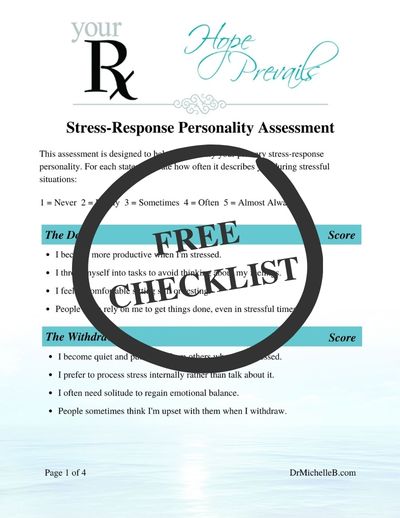
Stress rarely affects everyone the same way. Your brain, body, and emotions often respond in unique patterns shaped by your personality, past experiences, and nervous system.
This assessment will help you identify your primary stress-response personality so you can better understand how you react under pressure, recognize your stress patterns, and begin moving toward healthier, faith-filled responses.
Get the assessment here: Stress-Response Personality Assessment


